
In situ measurements, such as with a thermal response test (or TRT for short), are an essential part of geothermal borefield design. In today’s article, we introduce a new feature to analyse these TRTs directly within GHEtool Cloud, streamlining your design process and making it easier than ever to design borefields with confidence.
What is a Thermal Response Test (TRT)?
When there is no information available on the thermal properties of the ground for your particular project, it is good practice to measure them in situ with a thermal response test. With this test, it is possible to calculate the ground thermal conductivity, the effective borehole thermal resistance, and the undisturbed ground temperature.
For this measurement, a borehole is constructed in the same way as it would be done for the actual project (same diameter, depth, single or double U, and so on). After a period of a couple of days, when the borehole is again in thermal equilibrium with the environment, the measurement can start.
For the measurement itself, a data logger together with a heating element is connected to the borehole. After an initial period during which the fluid is circulated through the borehole (to measure the initial, undisturbed ground temperature), the heating element is turned on and the inlet and outlet fluid temperatures are measured. This measurement is carried out over a period of 48 to 72 hours (or sometimes even longer) to move past the initial transient effects.
!Hinweis
With a TRT, we aim to measure both the ground thermal conductivity and the effective borehole thermal resistance. To achieve this, a constant heat flux through the borehole to the ground is required. Initially, however, this heat is absorbed by the thermal inertia of the fluid and the ground, and it is only after ten or more hours that the energy is actually transmitted to the ground. This is called the transient period and is traditionally not considered when analysing the TRT measurement.

Analyse a TRT in GHEtool Cloud
Although there are many different models to analyse a TRT, the most commonly used one is the infinite line source (ILS) model, as developed by Gehlin (2002). This method assumes that the borehole can be represented as an infinitely long line that interacts with the surrounding ground. This model is currently implemented in GHEtool Cloud.
!Hinweis
For more information on the mathematics of the infinite line source, the reader is referred to this article.
Below, both the general settings for the model and the measurement data are discussed.
General settings
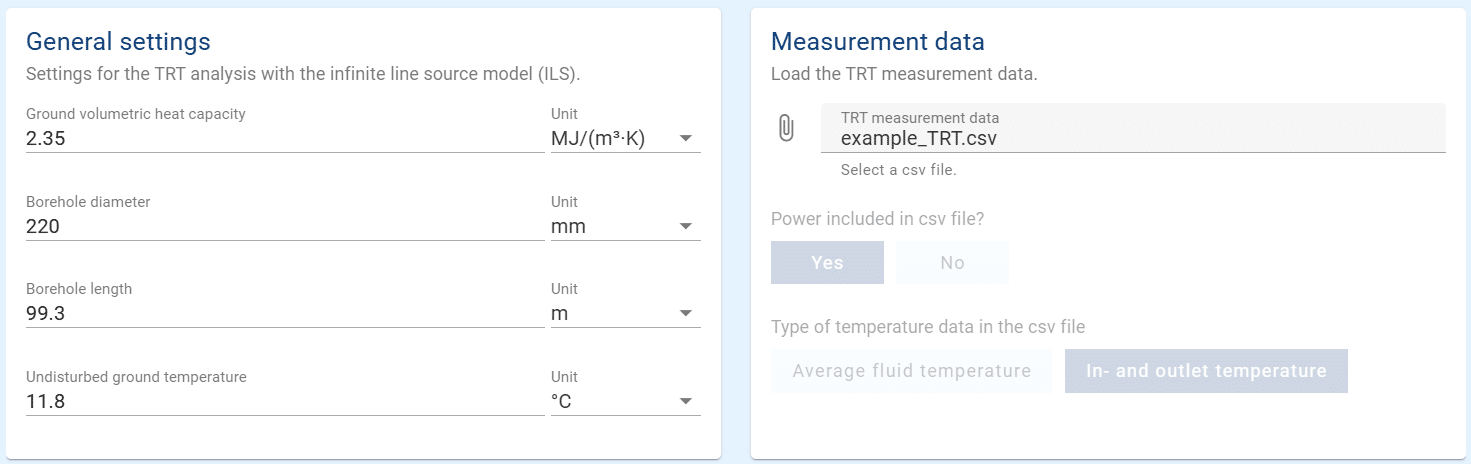
Besides the measurement data, a few input parameters are required to perform the analysis:
- Volumetric heat capacity of the ground
In order to calculate the ground thermal conductivity with a TRT, an estimate of the volumetric heat capacity is required. This can be done based on the geology at the project location and by using tables with general thermal properties, such as those mentioned in our article on ground data. - Borehole diameter and borehole length
Since the ILS model uses the specific heat injection (that is, the amount of power exchanged with the ground per unit length), both the borehole length and the borehole diameter are required. - Undisturbed ground temperature
As mentioned earlier, before the actual TRT measurement starts, the fluid can be circulated through the borehole without switching on the heating element. This allows the user to determine the initial undisturbed ground temperature, which is needed for the analysis of the TRT.
Measurement data
Depending on the data logger you use, the acquired data set might look slightly different (for example, some TRT machines also measure the flow rate and pressure drop through the system). The information that should always be provided, in one way or another, is:
- Time
To perform the analysis, a time series (in seconds) is required. - Power
It is important to know what (constant) power is injected into the ground. This power can either be entered manually as a constant or, if included in the measured data set, it can be extracted from that. - Fluid temperature
To understand how the borehole reacts to the injected power, the measurement of the fluid temperature is required. This can be done by providing both the inlet and outlet fluid temperatures or by using the average fluid temperature directly.
!Hinweis
It is important that only the steady state behaviour is taken into account when analysing the TRT, disregarding the first hours of the measurement. This can be done either by manually deleting the rows in the CSV file or by using the ‘start index’ value in GHEtool to specify the point at which the TRT measurements are considered to be in steady state.
Result of the TRT analysis
The TRT analysis is rather straightforward and provides both the ground thermal conductivity and the effective borehole thermal resistance. In addition, the measurement data and the linear regression are shown, allowing you to check how well the model aligns with the measurements. If, for example, the regression deviates in the first part of the measurement, it could indicate that the borehole was not fully in steady state, and it is advised to increase the start index (see previous section).

Fazit
TRTs are a crucial part of the design process for shallow geothermal borefields, especially when little is known about the thermal properties of the ground or the borehole. From today onwards, it is possible to analyse the measurements from this test directly in GHEtool Cloud, helping you streamline your design process, save time, and design better borefields.
Literaturverzeichnis
- Sehen Sie sich unsere Videoerklärung auf unserer YouTube-Seite an, indem Sie klicken hier.
 Deutsch
  English (UK)
  Nederlands