
The pressure drop and the thermal behaviour of borefields are the two aspects that are important for every design. In this exercise, we will take a closer look at the pressure drop, how it changes with different design options, and how it relates to our newest method.
The exercise
To stay in the mood for the approaching holiday season, we will take a look at a fictitious old bookstore in the city of Bremen (Germany). The whole corner block is being renovated and will be heated (and to a lesser extent cooled) with a geothermal borefield that can be drilled under a nearby square.
The goal of this exercise is to learn how the thermal design of a borefield also influences the hydraulic aspects, namely the choice between a single or double U tube, and whether the boreholes are connected in parallel, Tichelmann (reverse return), or in series. In addition, we will also learn how to calculate (or estimate) the flow rate through the entire borefield, as well as how the latest method to calculate both the required borehole size and depth (see our article hier) can speed up our design.

!Hint
To get the most out of this exercise, we strongly recommend attempting the design questions below before reading the provided solution. Borefield design is far from straightforward, and the best way to master its complexities is through hands-on experience.
Input parameters
General input parameters
- Minimum average fluid temperature threshold: -2°C
- Maximum average fluid temperature threshold: 17°C (active cooling)
- Simulation period: 50 years
- First month of the simulation: January
Ground input parameters
- Ground thermal conductivity: 1.6 W/(mK)
- Volumetric heat capacity: 2.4 MJ/(m³K)
- Surface temperature: 10°C
- Geothermal heat flux: 0.8 W/m²
Borehole resistance input parameters
The parameters for the pipe are:
- Double DN32 PN16 pipe (i.e. a wall thickness of 3mm and an outer diameter of 32mm)
- Borehole diameter: 140 mm
- Distance from pipe to borehole centre: 35 mm
- Grout: 1.8 W/(mK)
The fluid is 25 v/v% MPG with a temperature difference of 3°C across the borefield.
Thermal load input parameters
- Peak heating demand: 37 kW
- Yearly heating demand: 67 MWh
- Peak cooling demand: 4 kW
- Yearly cooling demand: 2.9 MWh
- SCOP: 5
- SEER: 20
- Peak duration heating/cooling: 8 hours
Borefield configuration
As a borefield configuration, a regular grid of 3 x 4 boreholes with a borehole depth of 120 m is selected. The buried depth is 0.7 m and the borehole spacing, as visible in the figure below, 6 m in both length and width direction.
Hydraulic configuration
The image below shows the position of the borehole relative to the corner building. The longest path from one borehole to the manifold is shown in light blue. This horizontal distance is 30 m.
!Hinweis
As mentioned in our article on the pressure drop calculations, we only need the worst-case horizontal connection, that is the longest one, to calculate the pressure drop of the entire borefield.

Design questions
For this exercise, you are invited to answer the following design questions while tracking the total borehole length for each step. This will help you assess the cost and performance implications of various design changes.
!Hint
To keep your work well-organised, it is recommended to use a separate scenario for each design question.
- Calculate the temperature profile and pressure drop with all the boreholes in parallel.
- Calculate the temperature profile and pressure drop with the boreholes connected in pairs of two in Tichelmann. What happens to the pressure drop in the borehole and in the horizontal connections?
- Calculate the temperature profile and pressure drop with the boreholes connected in pairs of two in series. What happens to the pressure drop in the borehole and in the horizontal connections?
- Let us keep the series connection and use a single DN40 instead of a double DN32. What is the resulting temperature and pressure drop?
- Use the new method to automatically calculate the required borefield size and depth (with the default settings) and use a series factor of 1. What is the proposed configuration? Can we explain this?
- Let us now do the same, but set the flow rate per borehole instead of for the entire borefield. Use the same flow rate you calculated, but divide it by the initial 12 boreholes. How does the optimal design change?
Calculate the flow rate
Before we can get started with the exercise, the flow rate through the entire borefield must be calculated. One way to do this is to look at the technical datasheet of the heat pump and search for the pump characteristics (see our article on this topic). However, when the heat pump is not yet selected, this is not an option. Another way is to calculate this based on the peak power of the heat pump, the efficiency, and the required difference between the borefield inlet and outlet temperature, which typically is between 3–5 °C.
Mass flow rate, temperature, and power are all connected via the following formula: $$\dot{Q}=\dot{m} \cdot C_p \cdot \Delta T$$
where $\dot{Q}$ is the power (in kW), $\dot{m}$ is the mass flow rate through the system (in kg/s), $\Delta T$ is the temperature difference between inlet and outlet (in °C), and $C_p$ is the specific heat capacity of the heat transfer fluid (in kJ/(kgK)). This last parameter depends on the type of antifreeze used, the fluid temperature, etc, but is generally around 4 kJ/(kgK). Therefore, the flow rate can be calculated as: $$\dot{m}=\frac{\dot{Q}}{4\cdot \Delta T}$$
!Caution
Please note that the power in the formula above is the extraction or injection power of the heat pump, not the heating or cooling capacity. Therefore, it is important to take the efficiency into account to translate the building power to a geothermal one.!Stay tuned
This rule of thumb can be used to estimate the flow rate through the system, but of course, since the heat pump can modulate and the specific heat capacity fluctuates as well, this flow rate is not constant. Therefore, next month, we will release a feature in GHEtool Cloud where you can specify the required $\Delta T$ so the software can calculate the corresponding flow rate for you.
Solution
Below you’ll find the answers to the design questions outlined earlier. It is important to emphasise that there is no single correct answer. The value of this exercise lies in understanding the reasoning behind each decision rather than strictly agreeing with every assumption.
Each geothermal project is unique, and the choices you make—regarding parameters, configurations, and thresholds—depend heavily on project-specific constraints, design priorities, and practical considerations. Use these answers as a guide, but don’t hesitate to challenge the assumptions and explore alternatives.
Question 1

Question 2
As a second option, we will put the boreholes in groups of two in Tichelmann (see our article on this topic to learn more). This minimises the cost of the total system by halving the number of required horizontal connections and using a smaller manifold with now only 6 instead of 12 connections. The pressure drop in the borehole, as well as the thermal behaviour of the system itself, is still the same, but the pressure drop in the horizontal connections has increased to 10.19 kPa due to the higher flow rate.
As you can see in the graph below, the jump is now below our designed flow rate, meaning the horizontal pipes are turbulent. The entire pressure drop is 23.3 kPa.

Question 3
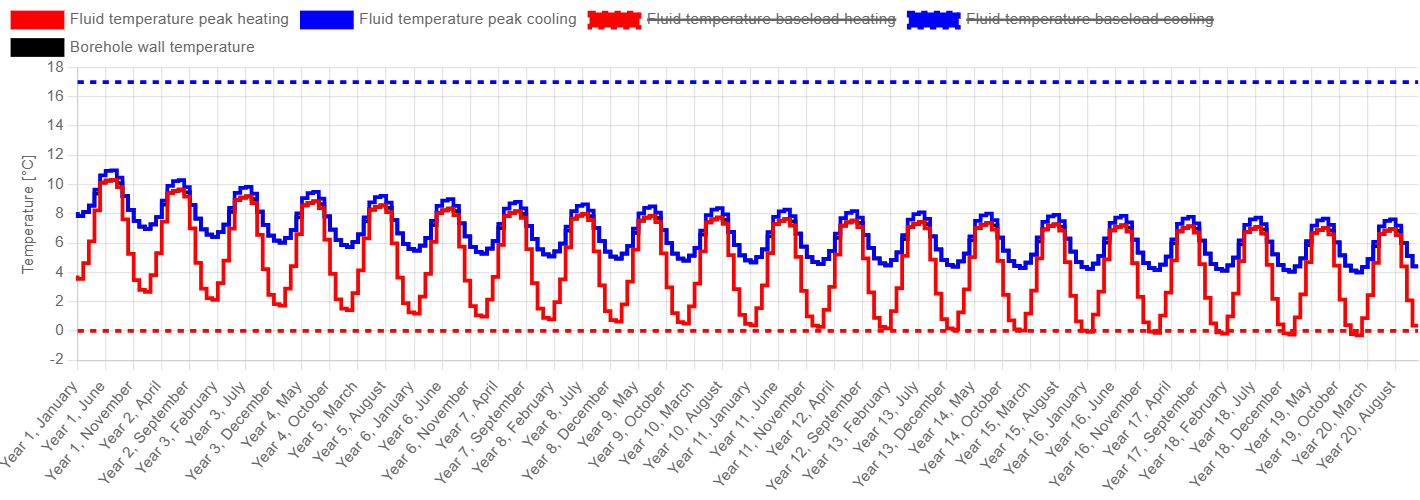
Because we are still in a laminar flow regime, our borehole resistance for the first two cases was only 0.1535 mK/W, which is not that great. Therefore, in this scenario, instead of connecting the boreholes in Tichelmann, we will connect them in series to double the flow rate through each borehole. The pressure drop in the horizontal connections is the same as in the previous case, but the pressure drop across one borehole is now 25.85 kPa and the flow is still laminar (Re = 1703 in extraction).
The borehole thermal resistance is therefore only slightly better (0.1388 mK/W), giving us a minimum average fluid temperature of 0.01 °C, just above the threshold.
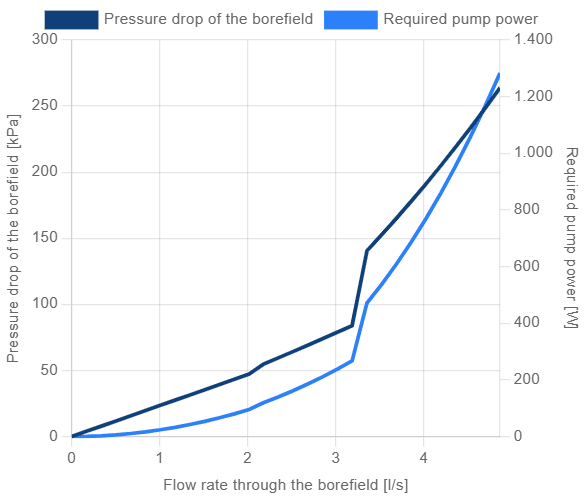
It is important to note that, since the boreholes are now connected in series, the entire pressure drop across the borefield is equal to two times the pressure drop of one borehole plus the horizontal connection. This gives a total pressure drop of 61.85 kPa. In the graph below, a second jump is now also visible where the double DN32 becomes turbulent. This is, however, above our design flow rate.
Question 4

The pressure drop for a single borehole, due to the turbulence, increased to 39.75 kPa, bringing the entire pressure drop to 89.61 kPa. In the graph below, you can see that there is now only one jump in the pressure drop, since both the horizontal and vertical connections are DN40s with the same flow rate.
!Hinweis
Although the mass flow rate has not changed, there is a slight difference in the pressure drop for the horizontal connections, now 10.11 kPa instead of 10.14 kPa before. Due to a different thermal behaviour, the fluid temperature is ever so slightly higher, giving a different fluid density and hence a different volume flow rate in l/s for the same and constant mass flow rate.

Question 5
In the scenarios above, we played around manually to find a good solution. The other alternative is to let GHEtool Cloud optimise this for you. When we set the series factor back to 1 and use the “calculate required size and depth” aim (with the default settings), the algorithm finds a solution with just 6 boreholes of 183.52 m deep, giving us a total borehole length of 1097 m instead of the 1432 m from before.
The reasoning behind this solution is:
- Drilling deeper gives a warmer ground temperature, which is beneficial in this extraction dominated and limited case (see our article on borefield quadrants).
- Fewer boreholes mean having a higher flow rate per borehole, and this optimal solution also has a transitional flow regime (Re = 2716 in extraction).
!Caution
Be aware that the horizontal length for the pressure drop calculation is not automatically updated when using this method.
Question 6
As a last variation, the same simulation is done as above, but now assuming a flow rate per borehole of 0.205 kg/s, which gives the same flow rate as before for our 12 boreholes. If we now run the simulation, we need 7 boreholes of around 193.8 m, which is significantly more than before. Since the flow rate is now fixed per borehole, the algorithm cannot optimise towards a turbulent regime with better heat transfer. Besides that, our total flow rate is now 1.435 kg/s, which is lower than the design flow rate we had.
It should be clear that when you use the “calculate required size and depth” aim, you should use the flow rate for the entire borefield.
Fazit
Literaturverzeichnis
- Sehen Sie sich unsere Videoerklärung auf unserer YouTube-Seite an, indem Sie klicken hier.
 Deutsch
  English (UK)
  Nederlands