
En el capítulo anterior se explicó el concepto de caída de presión y su importancia. En este capítulo profundizaremos en este concepto, examinaremos cómo evoluciona la pérdida de carga con el tiempo y estudiaremos cómo puede definirse la pérdida de carga crítica. También se introducirán los conceptos de potencia y energía de la bomba.
Profundización en la caída de presión
En Parte 4.1, el concepto de pérdida de carga se definió utilizando la configuración hidráulica (longitud, profundidad, pérdidas locales), así como las propiedades del fluido y del caudal. Sin embargo, como se ha comentado en la parte anterior, las propiedades del fluido e incluso el caudal no son constantes a lo largo del periodo de simulación. Las consecuencias de ello se detallan a continuación.
Propiedades variables de los fluidos
En Parte 3.2, se explicó la importancia de utilizar propiedades variables de los fluidos, centrándose en el diseño térmico del campo de perforación. Sin embargo, también hay un aspecto hidráulico, ya que cuando las propiedades del fluido varían con el tiempo, la caída de presión también cambia. En el gráfico siguiente, se muestra la caída de presión para diferentes caudales con 25 v/v% MPG durante la extracción y la inyección.
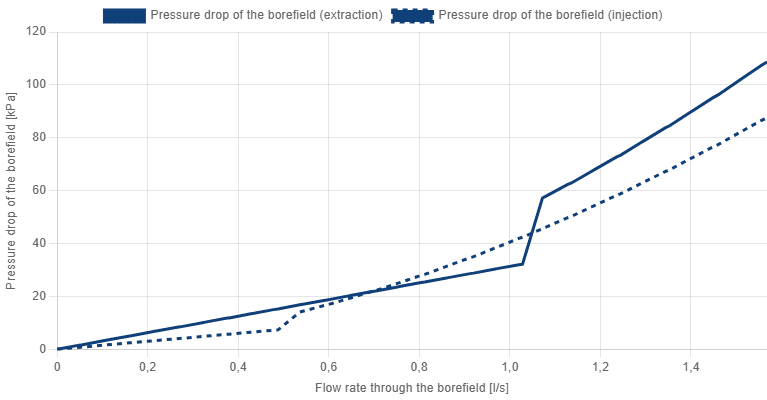
Es evidente que el flujo entra antes en régimen turbulento durante la inyección, como muestra el brusco aumento de la caída de presión en torno a 0,5 l/s, mientras que la transición se produce más tarde durante la extracción. Por lo tanto, dependiendo del caudal, será crítica la caída de presión durante la extracción o durante la inyección. Por ejemplo, para un caudal de diseño de 1 l/s, la caída de presión durante la inyección de unos 40 kPa será limitante, mientras que para un caudal de 0,5 l/s, los 18 kPa durante la extracción serán limitantes.
Por lo tanto, al seleccionar la caída de presión crítica (necesaria para el diseño de la bomba), deben tenerse en cuenta tanto las condiciones de extracción como las de inyección.
En el gráfico siguiente, se muestra un perfil de caída de presión horaria para un campo de sondeo con 4 perforaciones de 120 m de profundidad, una sonda doble DN32, 25 v/v% MPG y un caudal constante de 0,8 kg/s a través del campo de sondeo.

En el gráfico anterior se aprecian saltos bruscos durante los periodos invernales, mientras que la caída de presión sigue un comportamiento más suave durante el verano. Esto se debe a que las temperaturas del fluido en verano son más altas y, por tanto, el flujo sigue siendo turbulento (Re > 2300). Sin embargo, en invierno, la temperatura fluctúa significativamente y el flujo cambia con frecuencia entre los regímenes laminar y turbulento.

Cuando se compara el perfil horario de temperatura con el gráfico de caída de presión, este comportamiento resulta más claro. El acusado descenso de la temperatura en torno al 25 de enero también se aprecia claramente en el gráfico de caída de presión, lo que indica que el flujo se encuentra efectivamente en régimen laminar en ese momento.
Cuando se duplica el caudal, de modo que el sistema sigue siendo totalmente turbulento, desaparecen estos saltos en la caída de presión y se obtiene una curva suave, similar a la observada durante el periodo estival.

Caudal variable
Además de tener propiedades de fluido variables, el caudal también deja de ser constante, como se comentó en Parte 3.3. A continuación se muestra la caída de presión para los mismos 4 sondeos de 120 m de profundidad, con una diferencia de temperatura constante de 4 °C durante la extracción y la inyección (y un porcentaje de caudal mínimo de 30%).

Cuando se compara el gráfico anterior, con un caudal variable, con el de caudal constante, se observa inmediatamente que, por término medio, la pérdida de carga es menor en el caso de caudal variable. Esto se aprecia especialmente en verano, cuando la pérdida de carga era siempre elevada en el caso de caudal constante (debido al régimen de flujo turbulento), lo que no ocurre en este caso. Debido a las menores potencias punta (como puede verse en la demanda del edificio más abajo), el caudal es significativamente menor y, en consecuencia, las caídas de presión también son menores.

Teniendo en cuenta estos conocimientos sobre la evolución de la caída de presión a lo largo del tiempo, a continuación se explicarán los conceptos de potencia y energía de bombeo.
Potencia de bombeo
Una vez conocida la caída de presión en un momento dado, es relativamente sencillo calcular la potencia hidráulica necesaria para la bomba mediante la siguiente relación:$$P_h=\dot{Q}\cdot \Delta P$$donde$P_h$ es la potencia hidráulica en (kW), $\dot{Q}$ es el caudal en (m³/s) y $\Delta P$ es la caída de presión en (kPa).
Es importante tener en cuenta que la potencia hidráulica representa la potencia mínima teórica que debe suministrar una bomba para transportar una cantidad determinada de fluido a una presión determinada. Sin embargo, dado que las bombas no son ni mecánica ni eléctricamente ideales, el rendimiento global suele oscilar entre 50% y 90%, como se muestra en el gráfico siguiente.

La potencia eléctrica del sistema puede calcularse fácilmente, dado un rendimiento medio de la bomba $\eta$, como:$$P_e=\frac{P_h}{\eta}$$
Energía de bombeo
Una vez conocida la potencia eléctrica de la bomba de circulación, puede calcularse el consumo eléctrico de la bomba. Sin embargo, el método utilizado depende de si el campo de sondeo se ha simulado con un perfil de carga horario o mensual. Para ambos casos, el cálculo de la energía de la bomba se explica a continuación.
Perfil de carga horaria
En el caso de una simulación horaria, el cálculo de la energía de la bomba es bastante sencillo. Como la caída de presión y el caudal se conocen para cada hora, también se conoce la potencia de la bomba. Simplemente sumando la potencia necesaria en todas las horas del año, se obtiene la energía de la bomba. El consumo medio anual de energía de la bomba puede calcularse como:$$E_e=\frac{{suma_limits_{i=0}^{8760 n}{P_e(i)}}{n}$$donde $E_e$ es la energía eléctrica necesaria en (kWh), $P_e$ es la potencia eléctrica en el momento $i$ en (kW), y $n$ es el número de años del periodo de simulación.
Disponer de una simulación horaria tiene claras ventajas no sólo para el análisis térmico del campo de sondeo (como se comenta en Parte 3.1), sino también para el cálculo de la energía de la bomba. Anteriormente, se explicó la diferencia entre una caída de presión horaria con un caudal constante y variable, y se demostró que la caída de presión para el caso de caudal variable es, por término medio, mucho menor. En el gráfico siguiente se muestra el consumo acumulado de energía de la bomba (suponiendo un rendimiento de 70%) para ambos casos.

En el gráfico anterior se ve claramente que el caudal variable da como resultado un consumo anual de electricidad de la bomba significativamente menor que en el caso de caudal constante, a saber, 17 kWh/año frente a 224 kWh/año. Esto significa que el uso de un caudal variable en este caso reduce el consumo eléctrico de la bomba en 92%.
Perfil de carga mensual
Para una simulación horaria, el cálculo del consumo eléctrico de la bomba es relativamente sencillo. Sin embargo, para una simulación mensual no es así. Como el caudal no se conoce para cada hora, hay que hacer ciertas suposiciones para estimar la demanda de energía de la bomba. Por lo tanto, hay que distinguir entre el caso de un caudal constante y el de un caudal variable.
Flujo constante
En el caso de un caudal constante, la caída de presión máxima puede calcularse durante la extracción y la inyección considerando las temperaturas media mínima y máxima del fluido y utilizándolas para determinar la caída de presión. Una vez conocida, puede convertirse fácilmente en la potencia máxima necesaria de la bomba multiplicando la caída de presión por el caudal.
A partir de esta potencia máxima requerida, puede hacerse una estimación óptima del consumo energético de la bomba utilizando las horas a plena carga de la bomba de circulación. Para calcularlo, se divide la energía de extracción e inyección de carga base de cada mes por la potencia máxima de extracción e inyección para obtener las horas a plena carga. Sumando estos valores, se obtiene una estimación global de las horas a plena carga de la bomba de circulación.
Para el mismo caso anterior, utilizando ahora una simulación mensual, se calcula que la bomba de circulación tiene 3333 horas de plena carga, lo que supone un consumo de energía de la bomba de 100 kWh/año.
Caudal variable
En el caso de una simulación mensual con un caudal variable, se calculan para cada mes la caída de presión máxima y la correspondiente potencia necesaria de la bomba, tanto para la inyección como para la extracción. En lugar de tomar el máximo de estos valores y utilizarlo para calcular la demanda de energía de la bomba, la potencia mensual necesaria de la bomba (tanto para extracción como para inyección) se multiplica por las horas a plena carga de cada mes (tanto para extracción como para inyección).
Aunque el número total de horas a plena carga sigue siendo el mismo, el uso de diferentes potencias de bomba para cada mes da como resultado un consumo eléctrico de bomba más optimista de 37 kWh/año. Esto es de nuevo significativamente inferior al caso de caudal constante, 63% inferior para ser exactos, pero sigue siendo muy superior a los 17 kWh/año obtenidos de la simulación horaria con caudal variable.
Conclusión
En este capítulo se consideraron las variaciones horarias de la caída de presión, teniendo en cuenta tanto las propiedades variables del fluido como el caudal variable. Utilizando los conceptos de potencia de la bomba y consumo energético de la bomba, se demostró que el uso de caudales variables puede reducir el consumo eléctrico de la bomba en 92% en comparación con un caudal constante.
En el próximo capítulo se explicará el diseño hidráulico propiamente dicho, incluidas las conexiones horizontales entre los pozos de sondeo, junto con un ejemplo en GHEtool Cloud.
Preguntas
En el gráfico siguiente se muestran las caídas de presión durante el calentamiento y el enfriamiento, y se aprecia claramente la transición del flujo laminar al turbulento. Como era de esperar, la transición de flujo laminar a turbulento se produce antes durante el enfriamiento, ya que el número de Reynolds es mayor. ¿Cómo es posible que la caída de presión a 0,55 l/s durante el enfriamiento, que es turbulento, sea menor que la caída de presión durante el calentamiento, que es laminar?
¿Por qué la caída de presión en el gráfico siguiente, cuando se trabaja con un caudal constante, es mayor en invierno que en verano?
Referencias
- Grundfos. Cálculo del rendimiento de las bombas. Disponible en en línea. [última visita el 24-04-2026]