
In the previous two chapters, two different algorithms to optimise a hybrid geothermal system were discussed: one that maximises the geothermal power and removes the geothermal potential for power, and one that maximises the geothermal energy exchange, removing the geothermal potential for energy. Although both methods have their own strengths and weaknesses, one conclusion for both of them was that quite a lot of geothermal imbalance could remain after optimisation. That will be overcome with this last optimisation method.
Hybrid system optimised for balance
When the borefield is optimised for maximum geothermal balance, the design objective is the following:
Maximise the power in heating, cooling and/or domestic hot water that you can inject into or extract from the ground at all times in the simulation period, as long as the ground stays balanced.
At first glance, the design objective above is very similar to the one from the optimisation strategy for maximum power (Part 9.2), with the extra requirement of a balanced borefield. In fact, when the allowed percentage of imbalance is set to 100%, the solutions of both optimisation methods are identical.
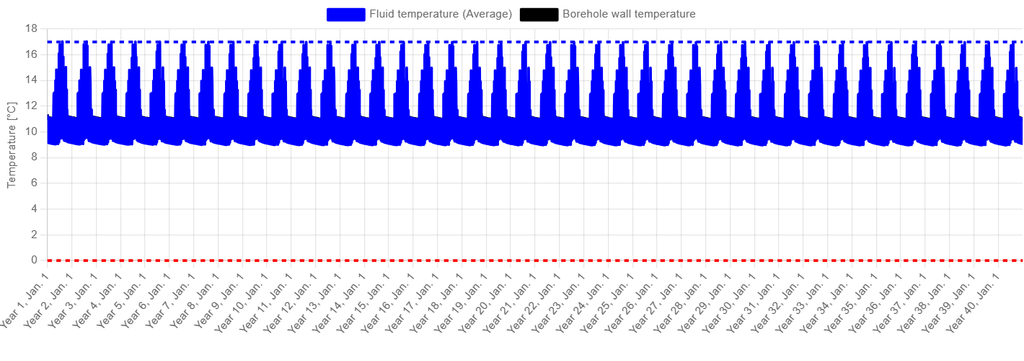
As is clearly visible in the temperature profile above, the borefield is now (almost) perfectly balanced, but of course at the cost of a remaining potential for power. However, just like with the optimisation for maximum geothermal power, the design objective above ensures that if x kW of geothermal heating, cooling or domestic hot water is installed, this installed power can be used throughout the whole simulation period. Therefore, this approach, just like the optimisation for power and in contrast with the optimisation for energy, yields no hybrid system oversizing.
Optimisation algorithm
Since the design of hybrid geothermal systems is not trivial and can sometimes give surprising results, it is important to understand the underlying optimisation algorithm in depth. The algorithmic reasoning is explained below.
- Start with an hourly heating, cooling (and optionally domestic hot water) demand profile and a certain fixed borefield design.
- Calculate the hourly temperature profile with 100% of the building demand being delivered by the geothermal borefield.
- Check whether:
- The minimum fluid temperature is below the set threshold or there is more than $\alpha$% imbalance for extraction.
If it is, the extraction power is too high, so it should be reduced by limiting either the heating or the domestic hot water demand. Depending on which one you want to reduce first, the heating or the domestic hot water demand will be reduced by x% for the entire simulation.
If the minimum fluid temperature is above the threshold, the current heating and domestic hot water demand can be provided by the geothermal borefield. - The maximum fluid temperature is higher than the set threshold or there is more than $\alpha$% imbalance for injection.
If it is, the injection power is too high, meaning that the cooling power should be reduced by x% for the entire simulation.
If the maximum fluid temperature is below the threshold, the borefield can handle the injection, and no changes are necessary.
- The minimum fluid temperature is below the set threshold or there is more than $\alpha$% imbalance for extraction.
- If both temperatures from step (3) are within the limits and the imbalance is less than $\alpha$%, the geothermal and hybrid loads are determined, and the algorithm goes to step (7). If at least one of the temperature thresholds is crossed, the algorithm continues with step (5).
- Recalculate the hourly load for the borefield using the new maximum peak powers for heating, cooling (and domestic hot water) as determined in step (3). Redirect the power or energy that cannot be handled by the borefield to the hybrid technology.
- Recalculate the hourly temperature profile and return to step (3).
- Done.
The optimisation algorithm above is very similar to the one from Part 9.2, with the important addition of an acceptable imbalance percentage. Graphically, this boils down to, again, a load-duration curve, but now one where the hatched area for the cooling equals the hatched area for the heating and domestic hot water, as shown below.

Example in GHEtool
In order to illustrate the advantages and disadvantages of this method when compared to the optimisation for power approach, the same example as in the previous chapter is discussed. To start, the same 5×5 borefield with a drilling depth of 100 m is considered. The geothermal share of the hybrid geothermal system is shown below.

What is immediately clear when looking at the figure above is that optimising for balance reduces the geothermal share for heating completely to 0. This is because, since there is much more extraction than injection, optimising for balance basically limits the system by the injection load. The temperature profile is given in the graph below, where this is clearly visible.

In the simulation above, an acceptable geothermal imbalance of 5% was allowed, and looking at the Sankey diagram below, the imbalance is indeed extremely small and most of the heating and domestic hot water demand is handled by the hybrid system.

When the borefield size is reduced to a 4×4 borefield, the following geothermal share is obtained. Now only half of the domestic hot water demand and 78% of the cooling demand remain. This is lower than the 62% and 94% of the 5×5 case. The reason is that now, since the borefield is smaller, the peak injection power it can handle is also lower, reducing the total share in cooling and, via the requirement of only 5% imbalance, also the domestic hot water demand.

As another variation, it is possible to increase the acceptable imbalance from 5% to, for example, 25%. By doing so, the geothermal share in domestic hot water can increase, because more imbalance is now allowed. This immediately changes the geothermal share in domestic hot water from 51% to 66%, with a temperature profile that looks like the one below.

Although there is significantly more imbalance in the profile above (6.7 MWh/year compared to 1.0 MWh/year), it is still barely noticeable. This once again illustrates that there is no silver bullet in the design of hybrid geothermal systems, and the methodologies as such are also developed to be very flexible, so that you, as a geothermal designer, can play around with them and find the most suitable solution for your particular project.
Conclusion
This chapter introduced the third method to design a hybrid geothermal system, namely one that maximises the geothermal balance. Basically, this method is a stronger adaptation of the optimisation for power methodology, with the extra requirement of a maximum acceptable geothermal imbalance.
In the example discussed, the optimisation for balance left no room for any heating demand on the borefield, due to the limited cooling load. The geothermal share therefore dropped significantly. When the allowed geothermal imbalance was increased to 25%, the geothermal share in the production of domestic hot water increased from 51% to 66%. This shows that the optimisation method for maximum balance is yet another tool in your arsenal for tackling complex hybrid geothermal system designs.
In the next chapter, a different approach will be introduced where the hybrid system is not optimised but simulated.
References
- Peere, W. (2025). Three ways to design a hybrid geothermal heating and cooling system for an office building. In Proceedings of Geo-Rin Conference. Benasque (Spain), 2-6 June 2025. [online]