
In almost all geothermal designs, you will encounter imbalance. Sometimes this is not a major issue, but in other cases it poses a significant challenge to keeping your borefield affordable and robust in the long term. In this article, we will explore how you can manage imbalance when designing your next borefield.
What is imbalance?
Imbalance is the yearly heating or cooling of the ground caused by a difference between the energy extracted from and injected into it on an annual basis. In that sense, it is entirely determined by your building’s energy demand and is something you simply have to learn to cope with. Below, you can see an example of an extraction dominated borefield.

The geothermal demand above translates into the extraction dominated borefield shown below. As you can see, the temperature drops year after year because more energy is extracted than injected. This places considerable stress on the minimum threshold at the end of the simulation period, as this becomes the critical design point. The greater the imbalance, the more borehole metres (and therefore investment) are required to cope with it.
!Note
Not all imbalance will by definition lead to more borehole metres and therefore higher investment costs. When there is a certain imbalance but your borefield is already limited in the first year due to a high peak power, it becomes less important. More information can be found in our article on the borefield quadrants.

In addition to having an extraction dominated borefield, it is also possible to have a case where the borefield heats up year after year. This occurs, for example, in office buildings with a high cooling baseload (such as server rooms) or in warmer climates where heating is less frequent.
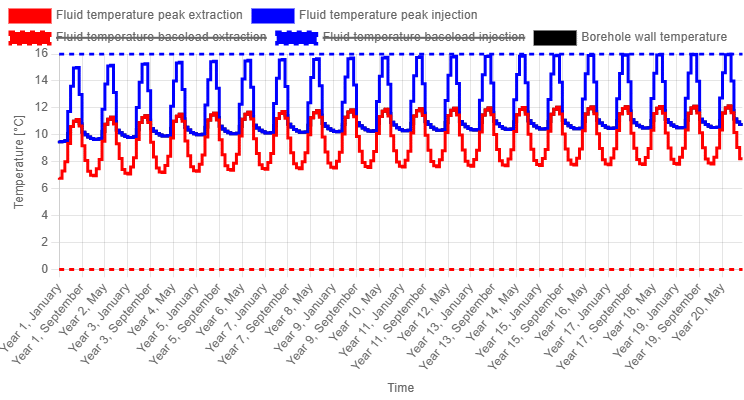
Avoid or cope?
It is clear that imbalance can cause considerable challenges for your borefield design, and as with most challenges in life, you can either try to avoid it or learn to cope with it.
As mentioned, the imbalance is determined by the building demand, since it is directly calculated from the building’s energy needs. However, as an architect or HVAC designer, you have a significant influence on this demand. Consider the orientation and size of the windows, the type of heat pump you select, or whether you choose a hybrid system. This approach to avoiding imbalance will be covered in next week’s article.

Also in the geothermal design phase of a project, there are multiple ways to cope with this imbalance. In the following section, we will discuss different approaches to optimising your geothermal design itself in order to minimise the (financial) impact of the imbalance.
Borefield design
The design of borefields is almost like a game with multiple strategies but no single best solution. In the next subsection, we will look at different aspects that can be considered when dealing with imbalance. Influencing the long-term and short-term behaviour will always have a beneficial effect and will be discussed first. Increasing the number of boreholes or drilling deeper ones will help in certain cases and will be discussed last.
Long-term
As discussed in our articles on the physics of borefields, two timescales are important in borefield design: the long-term (in the order of years) and the short-term (in the order of hours).

The long-term effect describes how the borefield changes over the years, and this is where the direct impact of the imbalance becomes visible. The more energy you extract on a yearly basis, the lower the temperature will be in the long-term (and vice versa for injection dominated systems).
As we discussed in our previous article, this long-term behaviour is governed by the g-functions that describe the borehole-to-borehole interactions as well as the interaction between the borefield and the surrounding ground. Whenever we change the borefield layout, the g-function adapts accordingly. To minimise the influence of the imbalance on the overall system, the configuration should have small g-values.

As can be seen in the figure above, there are several ways to influence the g-functions. One option, shown on the left, is to adjust the spacing. The further apart the boreholes are placed, the better they can exchange energy with the ground, and the smaller the impact of the imbalance will be. The same reasoning applies to the example on the right: if you change the borehole configuration to a more open arrangement (such as a line or an L shape instead of a rectangle), the borefield can exchange energy with the ground more effectively, thereby reducing the influence of the imbalance.
Short-term
The short-term effects (as discussed in this article)are related to the effective borehole thermal resistance. This value indicates how well the borehole can exchange heat with the ground, that is, how much thermal resistance exists between the fluid and the surrounding ground.
At first glance, this may not seem directly related to the problem at hand, since the effective borehole thermal resistance only has an instantaneous effect (linked to the peak power) and not so much a long-term effect. So why is it important for our discussion on imbalance? To answer that, let us take a look at the following two graphs, which show the same borefield configuration (that is, the same long-term effect).

The figure above shows a high effective borehole thermal resistance, as indicated by the large temperature difference between the peak heating temperature and the borehole wall temperature. There is a certain imbalance, but it is relatively small. If it were any greater, the minimum threshold temperature would be exceeded.

The graph above shows the same borefield as before (and therefore the same long-term behaviour). However, since the effective borehole thermal resistance is now significantly lower than in the previous example, the system can handle a much greater imbalance while still remaining above the temperature threshold of 2°C in this case. In other words, when the borehole resistance is low, a larger imbalance can be managed more effectively because it is easier to transfer energy between the fluid and the ground.
Extra boreholes
Another solution that is often proposed is to drill additional boreholes. The reasoning behind this is quite straightforward: with more boreholes, more energy can be exchanged with the ground. This follows the same logic we discussed earlier regarding borehole spacing and configuration. However, there is an important nuance here, which relates to the borehole resistance mentioned before.
One key parameter in the effective borehole thermal resistance is the flow regime (laminar or turbulent), which you can read more about here. When the number of boreholes in the system changes, the total flow rate (which is typically determined by the heat pump and the building demand) is divided among a different number of boreholes, resulting in a lower flow rate per borehole. In the graph below, this corresponds to moving towards lower Reynolds numbers.

When a borefield operates in the transient zone (between Re = 2300 and Re = 4000), lowering the flow rate per borehole can have a significant effect on the effective borehole resistance and therefore on the borefield’s ability to cope with imbalance (as discussed in the previous section).
Therefore, when adding more boreholes, it is always important to monitor this borehole resistance and, whenever possible, increase the flow rate or adjust the borehole configuration (single versus double U, pipe diameter, etc.) to keep the resistance as low as possible.
!Note
When there is a very significant imbalance, the only viable option may be to drill additional boreholes, even if this results in a higher effective borehole thermal resistance.
Deeper boreholes
A last resort for geothermal designers to cope with imbalance is to drill deeper boreholes. This slightly changes the g-functions and therefore the long-term effect, since deeper boreholes also provide more area for heat exchange with the ground. Moreover, a deeper borehole means a higher average ground temperature. This higher temperature shifts all the lines in the temperature graph above, making it easier to cope with imbalance.
It should be noted that this solution is effective only for extraction dominated borefields. When a borefield experiences problems with the maximum average fluid temperature, drilling deeper is generally not a good solution, as higher fluid temperatures will create additional challenges.
Conclusion
Imbalance can create considerable design challenges when trying to keep your borefield economically feasible. In this article, we discussed several approaches to coping with imbalance while aiming to keep your borefield as cost effective as possible. Increasing the borehole-to-borehole spacing and choosing an open configuration (such as a line or L shape), combined with lowering the effective borehole thermal resistance, are always good strategies to address imbalance.
Drilling additional boreholes can also be a good option, but close attention must be paid to the borehole resistance, since the flow rate per borehole will typically be lower when the number of boreholes increases. Finally, drilling deeper is an interesting approach to consider for borefields with an extraction dominated profile.
In the next article, we will take a step back and explore ways to avoid imbalance altogether. Stay tuned!
References
- Watch our video explanation over on our YouTube page by clicking here.