
In our first part, we mentioned that different load profiles can be used for a borefield simulation: monthly and hourly. Although monthly simulations are easy to start with, they do not offer the same level of insight as an hourly simulation. In this chapter, we will discuss the benefits of using hourly load profiles instead of monthly ones.
Hourly load profiles
In Part 1.4, the two different types of load profiles were discussed: monthly load profiles, with monthly values for the baseload and peak power for both heating and cooling, and hourly load profiles, where a value for heating, cooling (and domestic hot water demand) is given for each hour. An example of an hourly load profile is given below.

The advantage of working with an hourly resolution is that we have a good idea of what the actual load profile looks like, when heating and cooling occur, and what the duration of the peak power is. As we will see below, this last parameter in particular has a significant impact on the results of the monthly simulation.
Two cases
To illustrate the additional insights that can be gained when designing a borefield with hourly versus monthly loads, two different buildings will be discussed.
- An apartment building with a collective borefield. This building has a significant imbalance in extraction due to higher heating and domestic hot water demands.
-
An auditorium building, which has a high peak cooling demand (since the system is all air in cooling), but still shows an overall imbalance in extraction.
Both buildings were dynamically simulated, so hourly demand profiles for heating and cooling are available. The annual values for heating and cooling, as well as their respective peak powers, are given in the table below.
| Building | Power | Yearly energy | |||
|---|---|---|---|---|---|
| Heating | Cooling | Heating | Cooling | DHW | |
| Residential building | 62 kW | 77 kW | 120 MWh | 19 MWh | 60 MWh |
| Auditorium building | 32 kW | 90 kW | 38 MWh | 3.9 MWh | – |
By performing the simulation using both hourly load profiles and yearly values, we eliminate all other uncertainties and can focus solely on the design differences arising from the use of different load resolutions. Below, both the residential building and the auditorium building are discussed.
Residential building
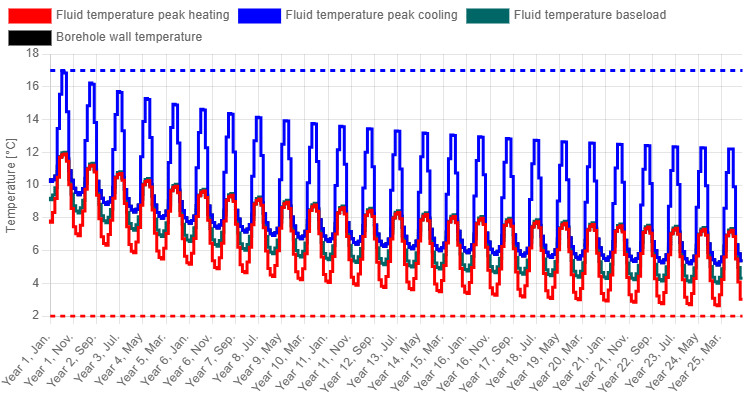
As was clear from the building demand itself, there is a significant imbalance in this borefield of around 116 MWh per year in extraction. However, this borefield is slightly more limited by the cooling demand in the first year (peak temperature of 16.92 °C) than by the peak heating demand in the 25th year (2.63 °C).
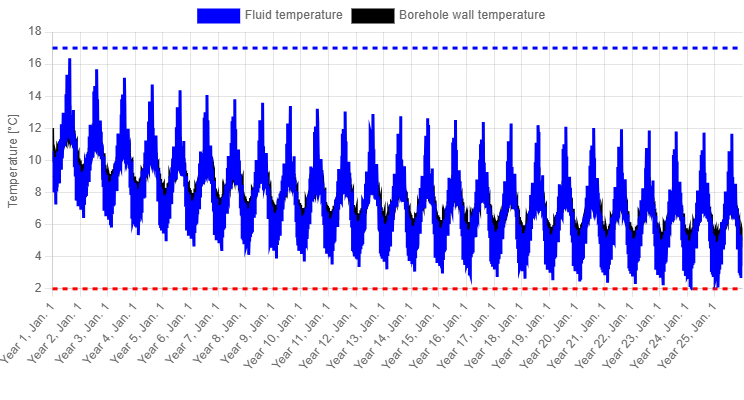
When we run the same simulation with the actual hourly load profile, we see that the same borefield is indeed sufficient (so our design was correct), but for a slightly different reason. Here, the minimum peak temperature in heating is 2.09 °C, and in cooling it is 16.36 °C. Whereas we previously believed that the cooling demand was the actual limiting factor for our borefield design, it is now clear that heating is the real limiting factor.
Where does this difference come from? The peak duration.
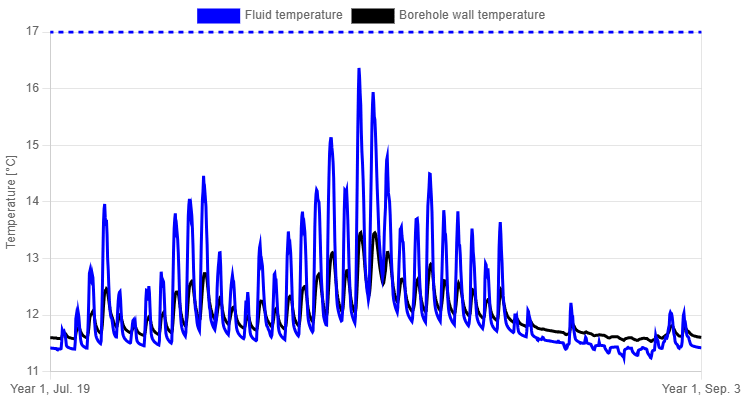
With the hourly data, we see that the peak cooling temperature only occurs for one hour, with the second highest temperature already below 16 °C. Assuming that the peak power lasted for 8 hours was, in this case, an overestimation. A close up is shown in the figure below.
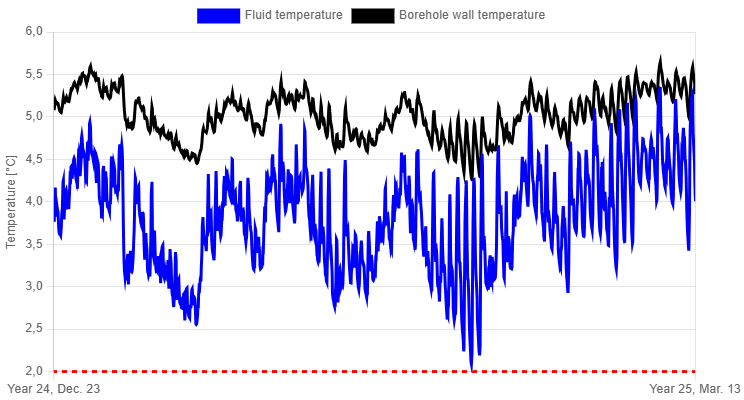
For the peak heating demand, the situation is the opposite: since the building uses underfloor heating, the temperature remains low for a much longer period (as shown in the figure below). In this case, a peak duration of 8 hours for heating was actually an underestimation.
Auditorium building
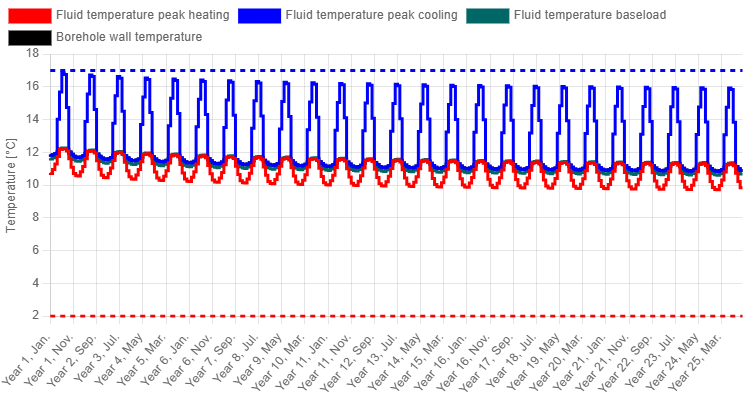
For the auditorium building, an initial simulation was also carried out using a monthly resolution, with a peak demand of 32 kW for heating and 90 kW for cooling, and yearly demands of 38 MWh and 3.9 MWh respectively. As shown in the figure below, this borefield is clearly limited by the peak cooling demand in the first year, and 9×4 boreholes, each 150 m deep, are required to meet the building’s needs. The maximum average fluid temperature reaches 16.85 °C.
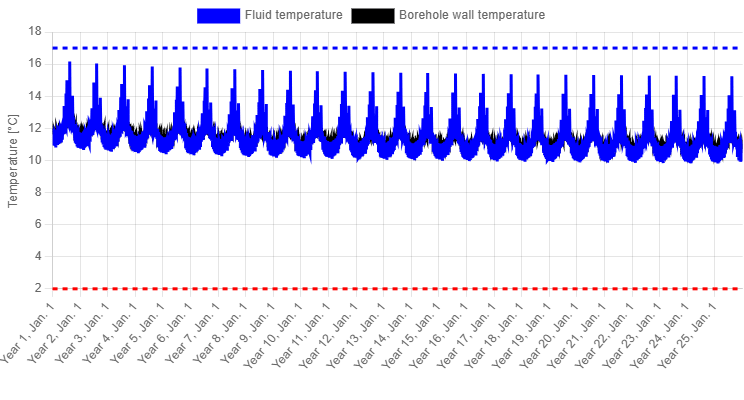
When the same simulation is performed with an hourly resolution, the profile below is obtained. In this case, the maximum temperature drops to 16.16 °C, indicating that the required borefield size was (significantly) overestimated in the monthly simulation. Since the cooling system in the auditorium is all air, the peak power is typically highly variable and has a relatively short peak duration.
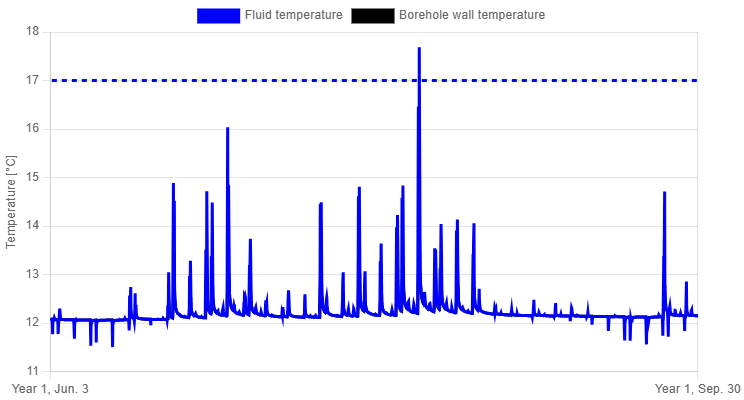
Since the borefield is now oversized, we could try to significantly reduce its size. When using a borefield of 7×4 boreholes (reducing the investment cost by 22%), we obtain a system that reaches a peak average fluid temperature of 17.69 °C, slightly above the allowed threshold. However, thanks to the hourly resolution of the data, we can see (as shown in the figure below) that this peak temperature occurs only once during the entire simulation, while the other peak temperatures remain well below 17 °C.
Using this hourly resolution, we can therefore confidently reduce the required borefield size and avoid uneconomical oversizing.
Conclusion
In this chapter, designing with both monthly and hourly load profiles was compared. It was shown that it is possible to obtain correct designs with both resolutions. However, due to the estimation of the peak duration when working with a monthly resolution, a certain level of nuance related to the minimum and maximum temperatures is lost.
With an hourly profile, you can clearly see how long a certain critical temperature is reached and, based on your best judgement, make design decisions accordingly. For example, if a threshold is only exceeded for 1 or 2 hours, given the inherent uncertainty of the profile, it may not make sense to size the system for that.
When working with monthly loads, you only see a single critical temperature and not how many hours within the month this occurs. Due to this lack of detail, it becomes more difficult to assess whether the borefield is over or undersized.
In general, designing with hourly data is preferred due to the higher level of detail. This level of detail can then be further enhanced using more advanced and accurate models, as explained in the next chapters, starting with variable fluid properties.
Question
Downloads
- Download GHEtool simulation from this chapter here.
- Download the hourly load profile for the auditorium and residential building.
References
- Peere, W., Hermans, L., Boydens, W. and Helsen, L. (2023). Evaluation of the oversizing and computational speed of different open-source borefield sizing methods. In Proceedings of the 18th IBPSA Conference, Shanghai, China, Sept. 4-6, 2023, https://doi.org/10.26868/25222708.2023.1287