
Modulating heat pumps are the newest and most performant type of heat pumps, but do we already take full advantage of their properties when we design borefields? In this article, we explore one of the most important assumptions in borefield design: the heat pump efficiency.
!Note
This article is based on research carried out by Enead BV in collaboration with Alpha Innotec and was presented at the geothermal congress in Frankfurt (18 – 20 November 2025).
Modulating heat pumps
Heat pumps are very interesting and sophisticated machines that can convert heat at a low temperature to heat at a high temperature by using a compressor. But although they might seem similar on the outside, there can be quite a lot of difference on the inside. One of these key differences is between on-off heat pumps and modulating ones.
When you have an on-off heat pump, your system is (as the name suggests) always 100 percent on or 100 percent off. This means that when your building has only a small demand for heating, your heat pump will switch on at maximum power, run for a short period of time and then shut down. This cycling behaviour causes quite a lot of wear on the compressor, which is why more and more manufacturers are switching to modulating heat pumps.
When your heat pump is a modulating one, it means that it can work at 100 percent of its capacity, but also at 70 percent or sometimes even 30 percent. This means that if your building has only a small demand, it can switch on at a much lower power, following the demand of the building more accurately. Therefore, modulating heat pumps have fewer start stops, lower wear on the compressor and are in general more quiet.
When a modulating heat pump is working in a part-load regime (that is, at a lower than maximum capacity) there is another great benefit. Since now, strictly speaking, the internal components of the heat pump are oversized relative to the heating demand, its efficiency is also higher. Therefore, modulating heat pumps tend to have a higher efficiency than on-off ones.
!Note
For completeness, on-off heat pumps can also have a form of modulation. For example, heat pumps with a higher capacity (for example 64 kW) typically have multiple compressors in parallel. If you have for example 2 compressors which together can deliver the full 64 kW, one compressor can deliver 32 kW, which can be interpreted as being 50% part-load.

Heat pump efficiency
The efficiency of heat pumps is not straightforward and depends on quite a lot of factors. One of the most important factors when it comes to the efficiency of heat pumps is what is called the lift, that is, the delta T the heat pump must deliver between the source temperature (that is, the ground in our case) and the building. The lower this lift, the higher the efficiency of the heat pump. With modulating heat pumps there is even one extra degree of freedom, namely the part-load behaviour, which has quite a lot of influence on the efficiency.
The efficiency of a heat pump can be defined as the amount of heat that can be delivered for a certain amount of electricity and is typically between 2.5 and 7. This efficiency is typically given in one of two ways:
- The COP or Coefficient Of Performance describes the efficiency of the heat pump at this very instant. It depends on the condenser and evaporator temperature and, in the case of modulating heat pumps, also the part-load power.
- The SCOP or Seasonal Coefficient Of Performance is a general parameter that estimates the average, seasonal efficiency of the heat pump, taking into account varying temperatures and different modulating degrees. It is calculated using a certain norm (for example EN 14825) and forms a baseline to compare the efficiency of different machines.
In general, the SCOP value for a certain source temperature is higher than the COP value for the same temperatures, since the SCOP provides a more averaged view of the efficiency than the COP does.
!Note
The SCOP is typically defined at B0/W35 where 0°C is the temperature of the antifreeze mixture in the ground and 35°C the water temperature it delivers to the building. For other emission systems that require a higher temperature (for example radiators) B0/W45 or B0/W55 values are also available.
Efficiency in borefield design
When you are designing borefields, you typically have a building load that you need to convert in one way or another to a ground load (that is, extraction and injection of heat). This is traditionally done by using an SCOP value that can be found in the technical data sheets. However, there are a couple of problems with this assumption.
-
By using the SCOP to convert the peak power heating to an extraction peak power, you overestimate the peak power, since the COP during peak conditions is typically lower than the SCOP. This can lead to an oversized borefield.
-
By using an SCOP at B0/W35 to convert the heating and domestic hot water demand to a ground load, you are assuming that the ground temperature is at 0°C. However, in most designs this only occurs, if ever, after a couple of years, meaning that the average temperature is higher. This gives a higher SCOP, so using a B0/W35 value is an underestimation of the efficiency and therefore of the imbalance, which can result in undersizing (see for example our article on how to cope with imbalance).
-
The efficiency of a heat pump depends on the ground temperature and will therefore change depending on your design. However, since the SCOP is typically an input instead of an output of a borefield design, the SCOP does not vary when the design changes. This is rather counter intuitive.
It should be clear that there are quite some challenges and uncertainties when using only an SCOP for the borefield design. That is why, in the next section, we introduce our newest research results on how to design with modulating and on-off heat pumps.
Three different efficiency assumptions
For three different buildings (a residential building, an office and a multi utility building) three different assumptions were investigated to convert the building load to a ground load:
- The traditional, constant SCOP (which in our case is 4.86)
- A temperature-dependent COP
- A temperature- and part-load-dependent COP
Although some software (like EWS and GLD) already take into account the temperature-dependent COP, there is currently no tool that can work with the part-load behaviour of a modulating heat pump.
The effect of the different assumptions on both the required borehole length and the final calculated efficiency is discussed below.
!Note
For the heat pump efficiency, the data from an SV62 Alpha Innotec heat pump was used.
Effect on required borehole length
When we look at the effect our efficiency assumption has on the required borehole depth, we see that there is almost no variation between the three different assumptions. In the case of the multi utility building, there is a slight increase in required depth for a design with a minimum average fluid temperature of 3°C when including the part-load dependency in the COP. The increase however is only 3 percent, which is negligible.
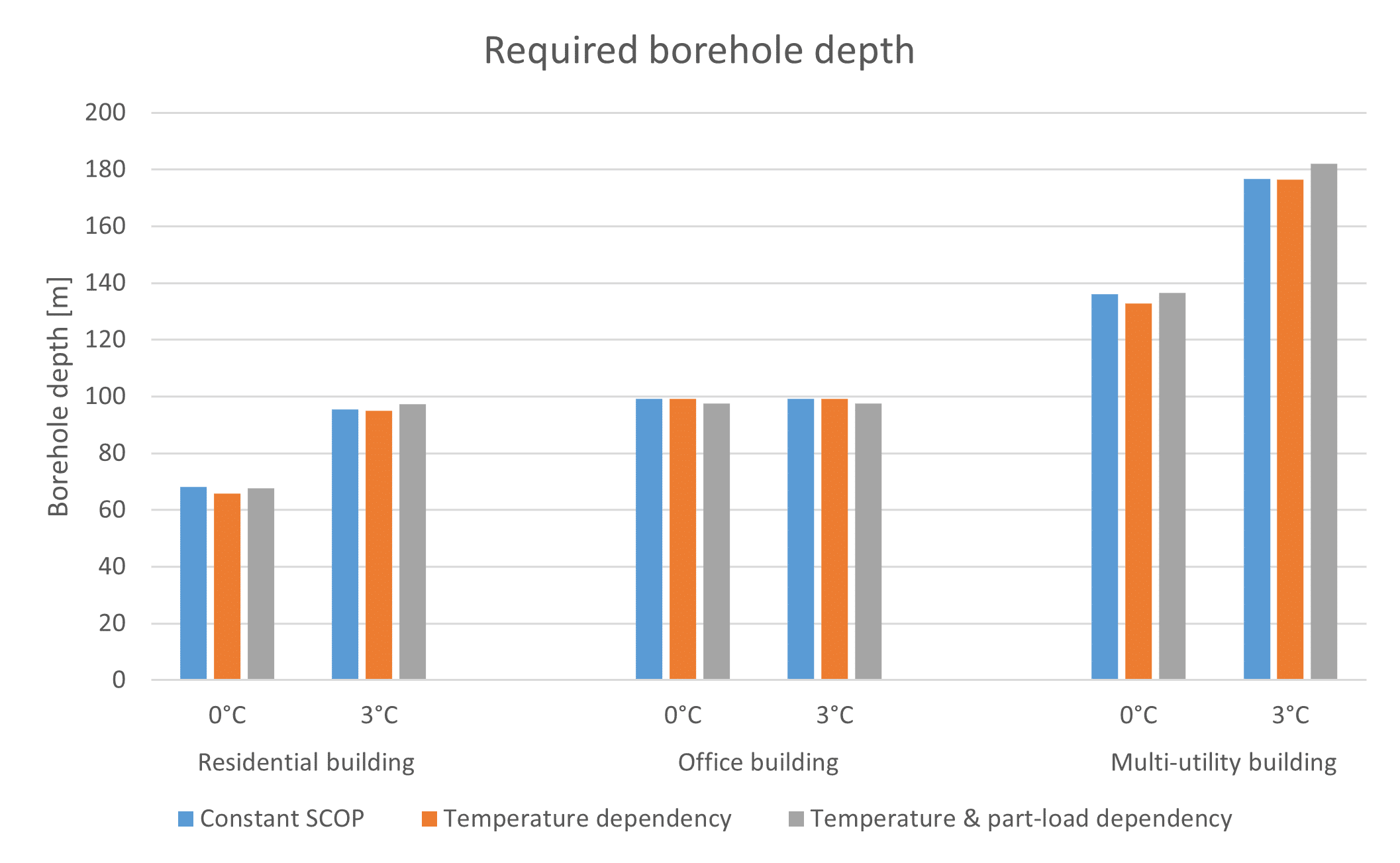
In short, based on the cases above, one can conclude that the overestimation of the peak power and the underestimation of the imbalance, as mentioned before, seem to cancel each other out, keeping the design rather similar to the SCOP B0/W35 design. However, the efficiency is quite different.
Effect on efficiency
Below, the average calculated SCOP is shown for the three different cases. It can be seen that although there is sometimes a slight difference, the official B0/W35 efficiency is rather close to the temperature-dependent COP. This means that, based on the examples below, there is no real reason to work with only a temperature-dependent COP, since it does not alter either the design or the SCOP.

In contrast, when we include the part-load dependency, there is a significant 10 to 50 percent difference in SCOP between the official B0/W35 and the expected efficiency. This is due to a double effect:
- The heat pump works most of the time in the more efficient part-load regime and
- In part-load, due to the lower heat extraction, the fluid temperatures are higher, leading to a more efficient operation.
To further explain the importance of the part-load dependency, we zoom in on the multi utility building. Below, the temperature profile is shown.

In the temperature profile above it is clear that the average fluid temperature fluctuates quite a lot. When we zoom in on the first 5 months and take a closer look at the COP of both the temperature-dependent COP and the temperature and part-load-dependent COP, we see that the variations in the latter are far more pronounced than when the part-load is not taken into account. Secondly, one can see that during peak moments, when both heat pumps are working in full-load, their efficiencies coincide.

In the graph below, the SCOP values are shown for every year of the simulation period of 20 years. It is clear that whenever we take into account the temperature dependency, the efficiency starts higher than it ends, due to the extraction dominated borefield. Most notably, the pure temperature-dependent COP ends up with a lower efficiency than the SCOP B0/W35 value after 20 years. This is because this assumption does not include a standard part-load behaviour, underestimating the efficiency when we are close to 0°C.
In contrast, the temperature and part-load dependent COP clearly shows the benefit of using a modulating heat pump, where the efficiency is significantly higher than the official 4.86 B0/W35 value.

Design with part-load COP’s
It should be clear that including the part-load efficiency in your design can have quite a lot of benefits.
First of all, your design will have an effect on the efficiency, so you can finally see the effects of having a higher or lower minimum average fluid temperature or working with deeper or shallower borefields.
Secondly, you will be able to evaluate the difference in efficiency when choosing between modulating or on-off heat pumps. In addition, you will be able to evaluate the benefits and risks of working with an oversized heat pump that can spend more time in part-load.
But most importantly, you will finally be able to showcase the real efficiency of a heat pump, which is typically far higher than the official B0/W35 value. Having an efficiency improvement of up to 50%, as in the office case above, could significantly alter economic evaluations in favour of the geothermal solution.
Conclusion
Nowadays, the official SCOP value is used to convert building loads to ground loads, ignoring the temperature and, most importantly, the part-load behaviour of a modulating heat pump.
Based on three case studies, it was shown that including this nuance in the geothermal design does not greatly change the final design, but it does significantly change the resulting calculated SCOP value.
Sizing with the heat pump in mind will be the next big step in geothermal borefield design, so stay tuned!
!Stay tuned
The design with part-load efficiency is coming to GHEtool Cloud in Q1 2026!
References
- Watch our video explanation over on our YouTube page by clicking here.
- Peere, W. (2025). Integrating Temperature and Part-Load Dependent COP in Shallow Geothermal Borefield Design. In Proceedings of German Geothermal Congress DGK 2025. Frankfurt (Germany), 18-20 November 2025.