
As a final chapter in this part, we will discuss one of the most common challenges in geothermal borefield design: imbalance. What tools do we, as designers, have at our disposal to modify the borefield design such that we can cope with it while keeping the investment cost manageable?
Imbalance and borefield design
Imbalance, being the difference between the extraction demand and the injection demand of the borefield, is a fact of life for a borefield designer. Whenever a project is being designed, this is typically a given, since it is directly related to the building demand and therefore to architectural choices. Although it is sometimes possible to change certain aspects of the building design, it is generally something that geothermal designers have to cope with.
Imbalance places stress on the long-term temperatures of the borefield. If temperatures need to remain within certain limits, a temperature drift will of course influence the design and will typically increase the investment cost.
In the following sections, several design choices that influence the way a borefield handles imbalance are discussed. These options are divided into solutions that always work and solutions that sometimes work.
Always beneficial for the imbalance
As discussed in Part 2, the thermal response of a borefield can be divided into two timescales: long-term effects and short-term effects.

Since imbalance is a phenomenon that causes problems in the long term, modifying the design to improve these long-term effects is a logical first step. What might be surprising at first is that short-term effects can also have a positive impact on the imbalance problem. The design choices that influence the long-term and short-term behaviour of the borefield will be discussed in the next two sections. A third section will…
Better long-term behaviour
The long-term effect describes how the borehole wall temperature changes over the years and is where the direct impact of the imbalance becomes visible. The more energy that is extracted on a yearly basis, the lower the borehole wall temperature will become in the long term, and vice versa for injection dominated systems.
As discussed in Part 2.3, this long-term effect is governed by the g-functions, which embody the thermal interaction between the different boreholes in the field and between the field and its surroundings. In order to minimise the drift in borehole wall temperature, the design should be adapted to achieve the lowest possible g-function.

As can be seen in the figure above, there are several ways to influence the g-functions. One option, shown on the left, is to adjust the spacing between the boreholes. The further apart the boreholes are placed, the better they can exchange energy with the surrounding ground, the smaller their mutual thermal interference becomes and, consequently, the smaller the impact of the imbalance on the system.
The same reasoning applies to the example on the right. If the borehole configuration is changed to a more open arrangement, such as a line or an L-shape instead of a rectangle, the borefield can exchange energy with the ground more effectively, thereby reducing the influence of the imbalance. This effect was also observed in the previous chapter, when discussing the importance of working with borehole coordinates.
Tilted boreholes
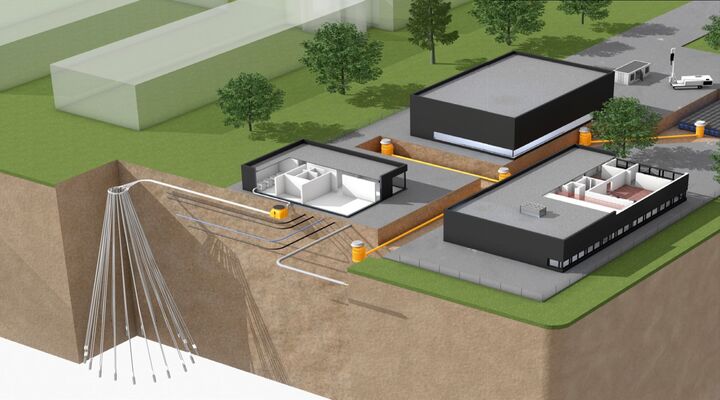
Another way to artificially increase the distance between boreholes is by inclining them. This approach is already common in Scandinavian countries and has led to concepts such as Celsius Energy‘s Energy Pyramid and the Geostar concept developed by Fraunhofer IEG.

Besides having the advantage of requiring a smaller footprint, thereby making it easier to install larger geothermal systems in densely built areas, if the boreholes are sufficiently deep, their average spacing becomes larger, reducing the thermal interaction between the boreholes and lowering the impact of the imbalance on the final design.
Better short-term behaviour
The short-term behaviour, as discussed in Part 2.2, is described by the effective borehole thermal resistance, which expresses the relationship between the borehole wall temperature, determined by the g-functions as discussed above, and the fluid temperature, which needs to remain within certain limits. It is precisely this relationship that makes the borehole resistance important when dealing with imbalance.
To understand this, let us take a look at the temperature profile below for a borefield consisting of 5 boreholes, each 113 m deep.
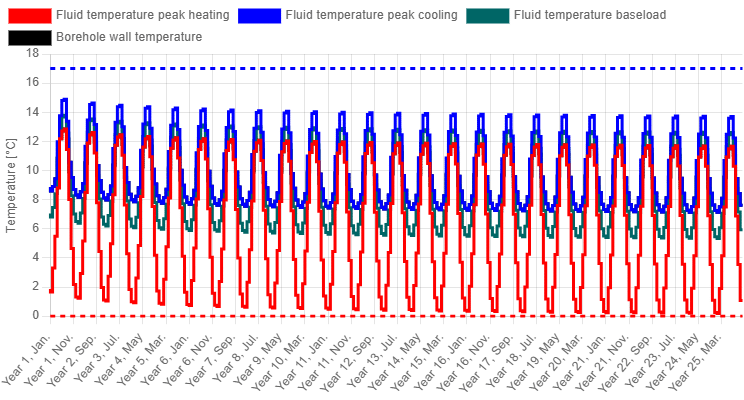
As can be seen in the figure above, the difference between the fluid temperature during peak heating and the borehole wall temperature, which is barely visible in this case, is rather large due to a relatively poor effective borehole thermal resistance of 0.1820 mK/W during extraction. The borefield above could handle a geothermal imbalance of 15.2 MWh/year in extraction.
When the borefield is kept unchanged and the borehole resistance is improved to a value of 0.0718 mK/W, the fluid temperatures become much closer to the borehole wall temperature. This means that the borehole wall temperature could decrease somewhat further over time while still keeping the fluid temperatures within their limits. It turns out that, in this case, the same borefield with 5 boreholes could handle an imbalance of 32.0 MWh/year in extraction with this improved borehole resistance.
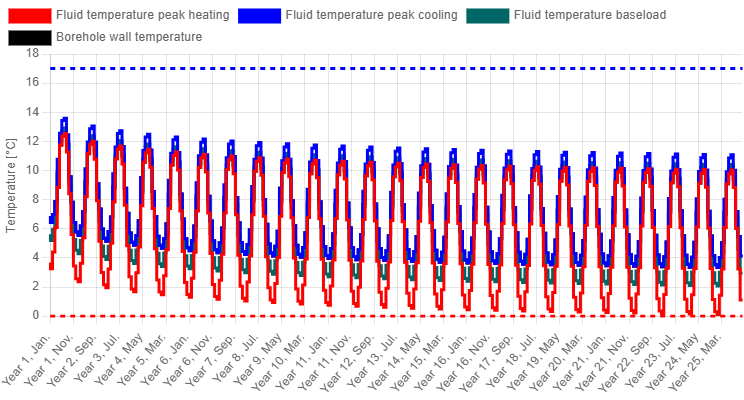
In other words, when the borehole resistance is low, a larger imbalance can be managed more effectively because energy can be transferred more easily between the fluid and the ground.
Sometimes beneficial for the imbalance
Besides the design choices above that are generally beneficial when dealing with imbalance, there are other design choices that may also be beneficial in certain cases.
Extra boreholes
A solution that is often proposed to cope with imbalance is to drill additional boreholes. The reasoning behind this is quite straightforward: with more boreholes, more energy can be exchanged with the ground. This follows the same logic discussed earlier regarding borehole spacing and configuration. However, there is an important nuance here related to the borehole resistance.
One key parameter influencing the effective borehole thermal resistance is the flow regime, whether laminar or turbulent. When the number of boreholes in the system changes, the total flow rate is distributed among a greater number of boreholes, resulting in a lower flow rate per borehole. In the graph below, this corresponds to moving towards lower Reynolds numbers.

When a borefield operates in the transient zone, between Re = 2300 and Re = 4000, lowering the flow rate per borehole can significantly increase the borehole resistance and, in turn, reduce the borefield’s ability to cope with imbalance, as discussed in the previous section. This means that although the long-term behaviour improves due to enhanced heat transfer with the surrounding ground, this benefit may be offset by poorer heat transfer inside the borefield itself.
Therefore, when adding more boreholes, it is always important to monitor the borehole resistance and, whenever possible, increase the flow rate or adjust the borehole configuration, such as choosing between a single and double U-tube or modifying the pipe diameter, in order to keep the resistance as low as possible.
Deeper boreholes
A last resort for geothermal designers when coping with imbalance is to drill deeper boreholes. This slightly changes the g-functions and therefore the long-term behaviour, since deeper boreholes also provide more area for heat exchange with the ground. Moreover, a deeper borehole generally means a higher average ground temperature. This higher temperature shifts all the lines in the temperature graph above upwards, making it easier to cope with imbalance
It should be noted that this solution is effective only for extraction dominated borefields. When a borefield experiences problems related to the maximum average fluid temperature, drilling deeper is generally not a good solution, as the higher ground temperatures will create additional challenges.
Conclusion
In this chapter, different strategies for coping with imbalance in geothermal borefield design were discussed. It was shown that imbalance mainly affects the long-term behaviour of the borefield by causing a drift in temperatures, which can increase the required borefield size and investment cost.
Several solutions were presented. Improving the long-term behaviour through larger borehole spacing, more open configurations or inclined boreholes helps reduce thermal interference, while improving the short-term behaviour through a lower effective borehole thermal resistance enables the system to manage larger imbalances more effectively. Additional boreholes or deeper boreholes may also help, although these solutions are not always beneficial and strongly depend on the specific project conditions.
The main takeaway is that there is no universal solution to imbalance. Each project requires a careful balance between thermal performance, hydraulic behaviour and investment cost.