
In this chapter, we will provide you with the answers to the question at the end of each chapter of the fifth part or the course.
Question 1.1
(Go to the original question)
All other things being equal, what would be the effect of the borehole diameter on the question of single or double U-tube? Assume that the pipes remain centred at half the borehole radius.
The borehole radius influences the thermal resistance between the pipe wall and the borehole wall. As the borehole diameter increases, heat transfer to the borehole wall becomes less effective. This effect can be observed in the graph below.
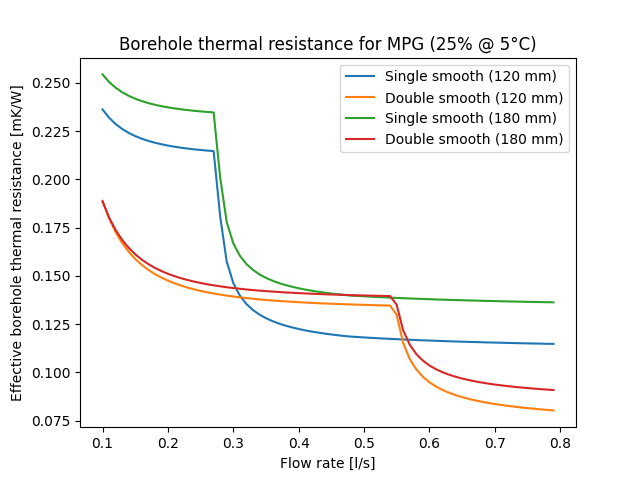
In the graph above, two borehole diameters were compared: 120 mm (with a corresponding distance between the pipe centre and the borehole centre of 30 mm) and 180 mm (with a corresponding distance of 45 mm). It is clear that the larger diameter results in a higher borehole resistance because the heat must travel a greater distance to reach the borehole wall. This effect is more pronounced for a single U-tube than for a double U-tube.
Question 1.2
(Go to the original question)
Due to a varying flow rate, the borehole resistance changes over time, and so does the ideal probe. What arguments are there for making a decision (single or double U-tube) based either on the lowest borehole resistance during peak power or on the lowest resistance during average conditions?
Question 2.1
(Go to the original question)
In the case of the simulation of our borefield with a variable flow rate and a single DN40 probe, the pump electricity consumption was lower than for the double DN32 probe, but the maximum pressure drop was actually higher (133 kPa compared with 119 kPa). Can you explain why?
This seemingly counterintuitive result comes down to the difference between pressure drop and pump electricity consumption. Pressure drop is an instantaneous property that changes from hour to hour, sometimes being higher and sometimes lower. Pump electricity consumption, on the other hand, is an annual value that accounts for all pressure drop values over the entire year.
In this particular case, the maximum pressure drop occurred during summer, when both probes were operating in the turbulent regime. Under these conditions, because the flow rate in the DN40 probe is higher than in the double DN32 probe, the corresponding pressure drop is also higher. However, on average, during laminar flow conditions, the pressure drop in the DN40 probe is lower than in the double DN32 probe, because it has a smaller surface area and therefore lower friction losses. As a result, the single DN40 probe can have a higher maximum pressure drop while still having lower annual energy requirements.
Question 2.2
(Go to the original question)
Although the design flow rate of 6.79 l/s was the same for both double DN32 simulations, the pressure drop during injection was different (119 kPa for the variable flow rate case and 142 kPa for the constant flow rate case). Can you explain why?
When performing an hourly simulation, the pressure drop is calculated for each hour, and the maximum value, for both heating and cooling, is returned. When using a variable flow rate, the highest pressure drop occurs at the peak cooling moment, when the flow rate is 6.79 l/s. However, when using a fixed flow rate, the situation is slightly different.
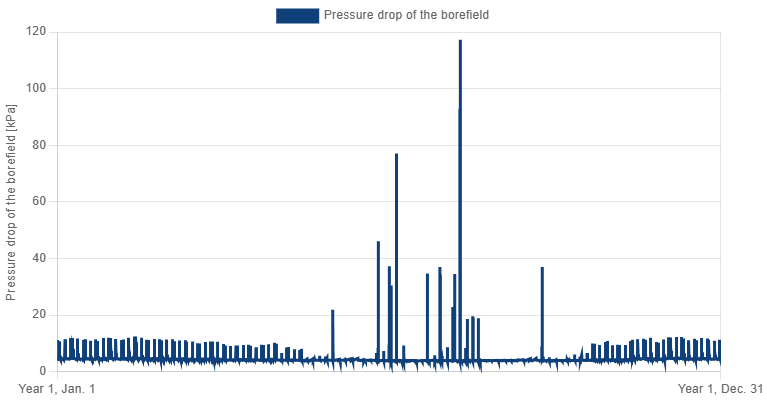
With a constant flow rate, the highest pressure drop occurs just after the heating period, in this case at the beginning of April. This is because the fluid temperatures are lower after winter, which results in a higher viscosity and therefore a less favourable friction factor. Since the flow rate is constant, this represents the worst pressure drop. This is also visible in the figure below, where the pressures are indeed higher in April and May than in mid-summer.

Note that, in the profile above, the low spikes actually correspond to the same moments as the high spikes in the variable flow rate case (see the graph below). This is because, at these moments, the fluid temperature is at its highest, resulting in the lowest pressure drop. In contrast, for the variable flow rate case, these same moments correspond to the highest flow rates and therefore the highest pressure drops.
This illustrates that pressure drop behaviour is not always as straightforward as it may appear at first glance. The combined effects of flow rate, fluid temperature, viscosity, and flow regime can lead to seemingly counterintuitive results when comparing different operating strategies.
Question 2.3
(Go to the original question)
In the case of a variable flow rate, the electricity consumption of the circulation pump for the single DN40 was lower than for the double DN32, but in the case of a constant flow rate, the opposite is true. Can you explain why?
The explanation for this behaviour is similar to that given in Question 2.1. When using a variable flow rate, both pipe configurations operate in the laminar regime for more than 90% of the time, a condition under which the single DN40 performs more favourably. As a result, it exhibits a lower average pressure drop and therefore lower pump electricity consumption.
When a constant flow rate is used, however, both pipe configurations operate entirely in the turbulent regime. Under these conditions, the double DN32 configuration has a lower pressure drop than the single DN40. Consequently, the pump electricity consumption is higher for the single DN40 when operating with a constant flow rate.
Question 3.1
(Go to the original question)
Can you explain why, when initially switching from a rectangular grid to the real borehole coordinates, the maximum average fluid temperature increased from 16.95°C to 17.21°C?
This behaviour is caused by the same g-functions that provide the long term benefits of using the exact borehole coordinates. As discussed earlier, using the exact coordinates results in lower g-function values, which reduces the impact of the thermal imbalance over time.
However, there is also a downside. Because the thermal interactions between the boreholes are reduced, the cooling effect stored in the ground during winter as a result of heat extraction is also less pronounced. Consequently, the ground temperature during summer is slightly higher. This explains the increase in fluid temperature from 16.95°C to 17.21°C. The corresponding borehole wall temperatures at these moments are 13.45°C and 13.72°C, respectively.
Question 3.2
(Go to the original question)
The custom configuration had a minimum average borehole spacing of 5.5 m instead of the assumed 5 m. What changes when the initial rectangular configuration is changed to work with this larger borehole spacing?
In this case, the minimum average fluid temperature is 0.25°C, compared to -0.05°C when using a uniform borehole spacing of 5 m. Although this represents an improvement, it is still significantly lower and therefore remains an underestimation of the minimum average fluid temperature of 0.96°C obtained when using the actual borehole coordinates.
Question 4.1
(Go to the original question)
It was mentioned that there are cases in which adding an extra borehole to cope with imbalance makes no difference at all to the final temperature. Can you create such a situation in GHEtool?
The way to demonstrate this effect is to start from a situation where the Reynolds number is just above the transition threshold of 2300. Using the same project as above with a borehole spacing of 5.5 m, this can be achieved with a single DN32 probe, a variable flow rate corresponding to a 3°C temperature difference between the borefield inlet and outlet, and a 23 v/v% MPG mixture. Under these conditions, the borehole resistance during extraction is 0.1781 mK/W, with a corresponding Reynolds number of 2404. This results in a minimum average fluid temperature of -0.09°C.
If an additional borehole is then added, the flow rate per borehole decreases and the Reynolds number drops to 2239. The flow regime therefore becomes laminar, causing the borehole resistance to increase to 0.2261 mK/W. As a consequence, the system with 16 boreholes reaches a minimum average fluid temperature of -0.23°C, which is lower than that obtained in the original simulation.
This example illustrates that adding a borehole does not always lead to improved thermal performance. When the reduction in flow rate causes the flow regime to transition from turbulent to laminar, the resulting increase in borehole resistance can outweigh the thermal benefit of the additional borehole.
Downloads
- Download GHEtool simulation from this chapter here.