
In Parts 2 and 3, the theory behind the thermal behaviour of borefields was discussed extensively. In this chapter, we will use this knowledge to answer one of the most common questions in geothermal design: “Which is better, a single or a double U-tube?”
Single or double U-tube? That is the question.
In the world of geothermal design, few topics seem as sensitive or as likely to spark debate as the question of using a single or a double U-tube. As soon as you begin to answer this question, you find yourself in a rabbit hole of differing viewpoints and some surprising considerations.
In this chapter, the focus will be on the thermal behaviour implications of both design choices, whereas in Part 5.2, the focus will be on the hydraulic aspects.
Thermal aspects
When discussing the thermal aspects related to the choice of geothermal heat exchanger, the focus lies on the effective borehole thermal resistance. As discussed in Part 2.2, we want this borehole resistance to be as low as possible in order to enhance the heat transfer between the fluid and the ground. Having a lower borehole resistance generally leads to fewer borehole metres (and hence a lower investment cost) and an overall better performance of the system.
Below is a graphical representation of the different elements that make up the effective borehole thermal resistance.
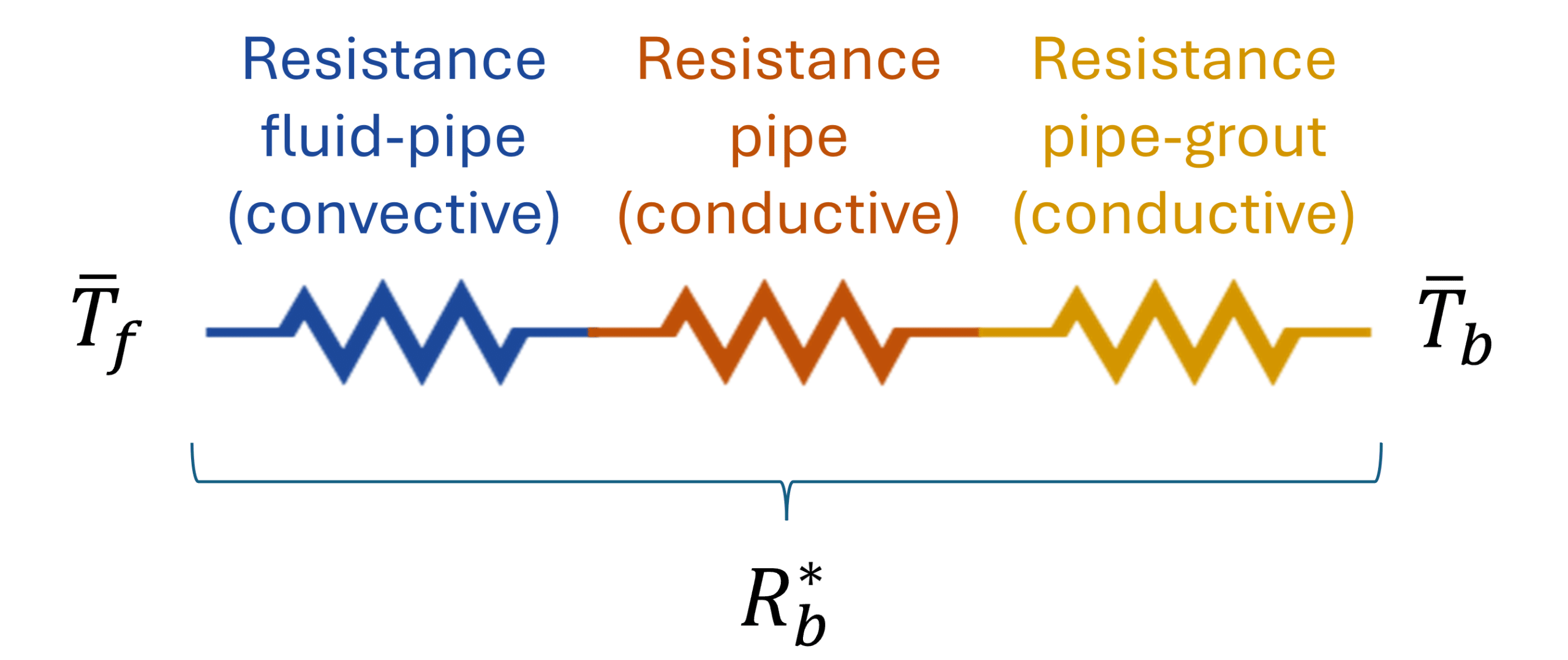
In our discussion of single and double U-tubes, the main factor is convective heat transfer, particularly the transition from laminar to turbulent flow. The pipe to grout conductive resistance is also important, since a double U-tube has twice the heat transfer area of a single U-tube and therefore its resistance will be lower. The pipe resistance itself plays a smaller role here since the pipe material and wall thickness remain constant, unless stated otherwise.
In the following sections, some key thermal aspects are discussed:
- The influence of fluid selection (e.g. which the type of antifreeze is used)
- The influence of the thermal conductivity of the grout
- The influence of varying fluid properties
- The influence of a variable flow rate
All simulations below are performed using a borehole with a depth of 100 m and a buried depth of 70 cm. The borehole diameter is 140 mm, the grout conductivity is 1.5 W/(mK), and the ground thermal conductivity is 2 W/(mK). The pipes are placed at exactly half the borehole radius, i.e. at a distance of 35 mm between the borehole centre and the pipe centre. The fluid used is MPG with 25 v/v% at 5°C. All pipes have a PN16 (SDR11) pressure rating and a thermal conductivity of 0.4 W/(mK). The default pipe diameter is 32 mm. All deviations from the assumptions above are explicitly mentioned below.
Influence of the fluid selection
The graph below shows the effective borehole thermal resistance for both a single and a double U-tube at various flow rates. As can be seen, both graphs display a sharp decrease at the point where the fluid transitions from laminar to turbulent flow, as discussed in Part 2.2. During this transition, the convective component of the borehole resistance decreases significantly, causing the total resistance to decrease as well.
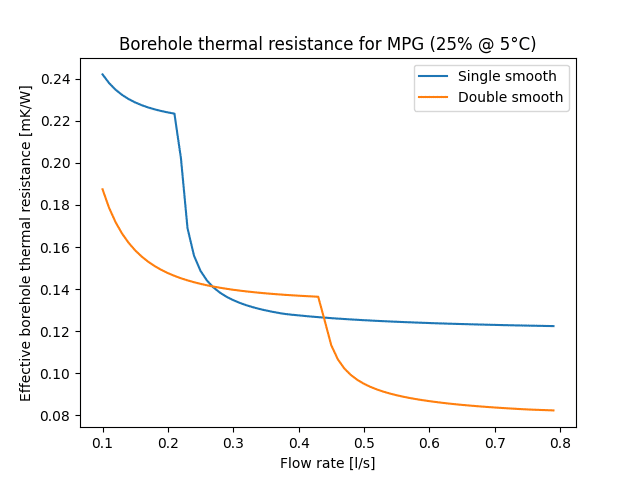
In the graph above, it is clear that this transition occurs at approximately half the flow rate for the single U-tube compared with the double U-tube. This is because, in a double U-tube, the flow is divided between two pipes, whereas in a single U-tube it passes through only one.
In this case, there is a window (between 0.25 and 0.45 l/s) where the single U-tube shows a lower borehole resistance and therefore delivers better thermal performance than its double U-tube counterpart.
The position and size of this “window of opportunity” depend strongly on the Reynolds number, which itself depends on both the fluid properties (see later) and the pipe diameter. In the graph below, a single DN40 probe is added to the comparison.
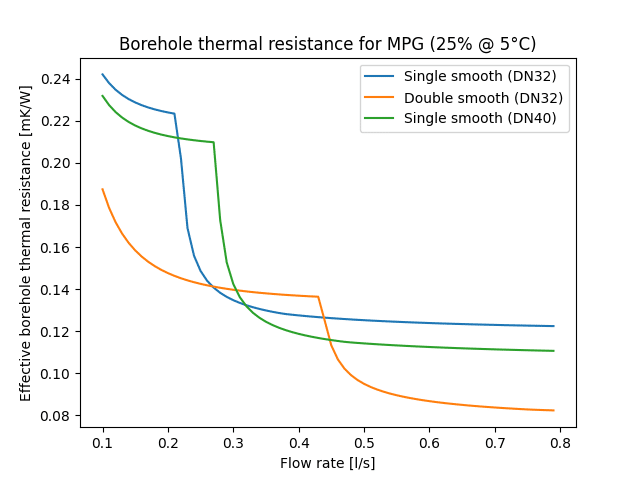
Due to the larger diameter, the transition to turbulent flow occurs at a higher flow rate (just before 0.3 l/s). This means that the flow range in which the single DN40 performs better than the double DN32 is smaller compared with a single DN32, although the relative improvement is greater.
Besides the pipe diameter, the Reynolds number is also influenced by the type of antifreeze. In the graph below, the same comparison between a single and a double U-tube is shown for plain water. Owing to its favourable viscosity, water reaches turbulent flow at very low flow rates.
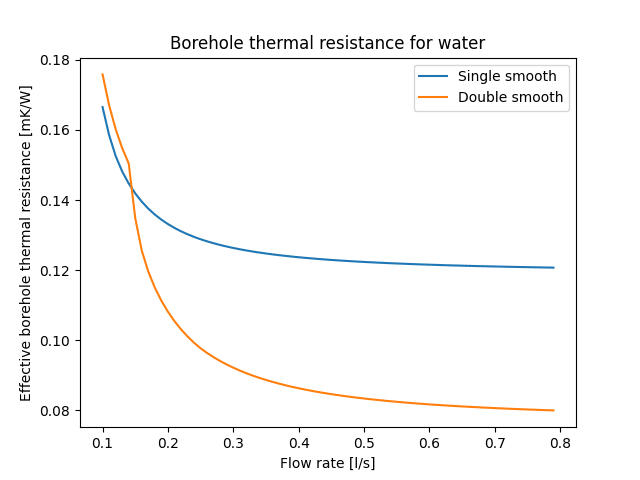
In this case, the window in which a single U-tube performs better than a double U-tube is very small (<0.15 l/s) and almost non-existent in practice. It can therefore be said that, in the situation above, the double U-tube consistently outperforms the single U-tube in terms of thermal performance.
Influence of the grout conductivity
One aspect that may be surprising at first is that the grout thermal conductivity also plays a role in this debate. As recapped at the beginning of this chapter, the third component of the borehole resistance is the pipe-to-grout conductive resistance.
Since the energy must travel from the pipe to the borehole wall through the grout, using a grout with a higher thermal conductivity (for example 2 W/(mK)) will improve the performance of the system. In the figure below, the same comparison is made, but with the grout thermal conductivity reduced to 1 W/(mK), causing the advantage of the single U-tube to disappear.

The reason why there was previously a range of flow rates in which a single U-tube outperformed a double U-tube was the decrease in the convective component of the effective borehole thermal resistance. Now that the grout has a lower thermal conductivity, this resistance plays a dominant role in the overall resistance. Since a single U-tube has only half the heat transfer area of a double U-tube, the transition to turbulent flow is no longer sufficient to overcome this limitation. The heat becomes, so to speak, “trapped” around the single U-tube.
Influence of variable fluid properties
As discussed in Part 3.2, the fluid properties are not constant over time, since they change with temperature. This implies that the window of opportunity in which the single U-tube outperforms the double U-tube is not fixed, but depends on the temperature being considered. To provide the complete picture, the graph above is revisited below, now for fluid temperatures of both 0°C and 17°C.
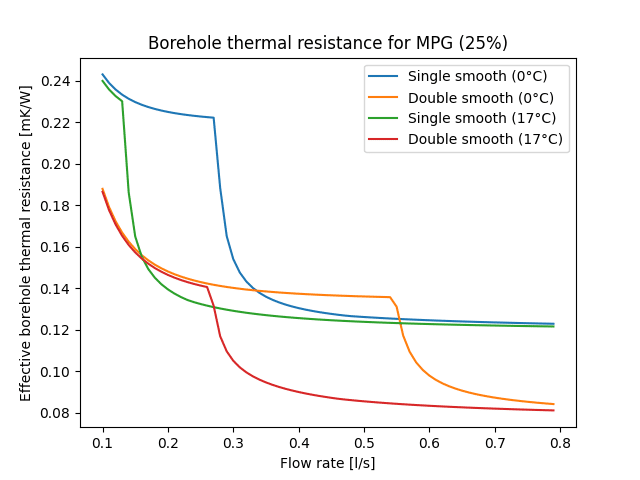
In the graph above, it is clear that a higher fluid temperature causes the transition to turbulent flow to occur at a lower flow rate. The reason why this is important was discussed in Part 2.1. Borefields can be limited either by the maximum average fluid temperature or by the minimum average fluid temperature and, depending on which of the two is critical, the answer to our question may vary. Both cases are shown below.

The borefield above is clearly limited by the minimum average fluid temperature of 0°C. To improve this design, we therefore need to decide whether to use a single or a double U-tube at a reference temperature of 0°C. Looking at the graph above, represented by the orange and blue lines, it is clear that for a design flow rate between 0.35 and 0.55 l/s, the single U-tube has a lower resistance than the double U-tube and could therefore allow for a smaller borefield size.

The borefield above, on the other hand, is clearly limited by the maximum average fluid temperature of 17°C. To improve this design, we need to decide whether to use a single or a double U-tube at a reference temperature of 17°C. Looking at the resistance graph above, represented by the green and red lines, we see that there is a window between 0.15 and 0.25 l/s in which the single U-tube outperforms the double U-tube.
Influence of variable flow rate
Previously, all these graphs were created as a function of the flow rate, but as discussed in Part 3.3, this flow rate is not constant over time. This means that, in theory, the ideal probe design also varies over time due to the varying flow rate, and you have to consider how to decide what is better for your case: the single U-tube or the double U-tube. This makes the decision of which probe to select even more project-specific.
In the sections above, the fluid temperature was always assumed to be constant and independent of the flow rate. However, this is not entirely correct. When the flow rate is lower, the borehole resistance changes and so does the fluid temperature. This, in turn, changes the Reynolds number again, which influences the borehole resistance, and so on.
In the graph below, the single and double U-tubes are shown for both a fixed fluid temperature limit, at 5°C, and a more realistic temperature. This realistic temperature was calculated using an initial ground temperature of 9°C and an extraction power of 3 kW from the 100 m borehole.
Since $\Delta T =\dot{q}R_b^$, where $\Delta T$ is the temperature difference between the borehole wall and the fluid in (°C), $\dot{q}$ is the specific power extraction in (W/m), and $R^_b$ is the effective borehole thermal resistance in (mK/W), the fluid temperature can be calculated for every borehole resistance.
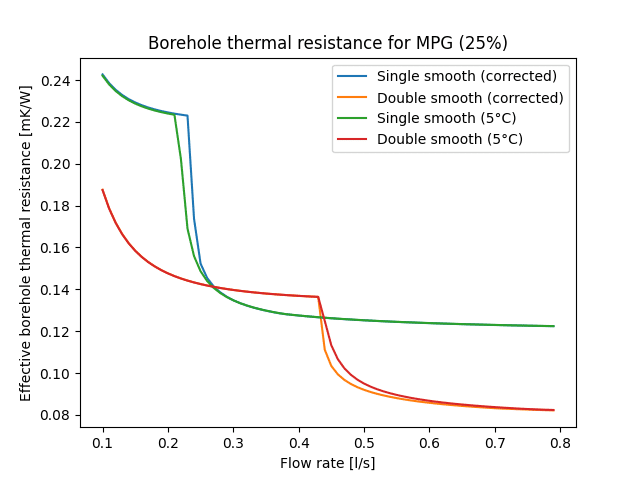
It is clear that the cases with the constant temperature, represented by the green and red lines, are rather similar to the temperature corrected ones, represented by the green and blue lines. The main difference is in the transition zone, where some deviation is visible due to the interaction between the borehole resistance and the fluid temperature.
Example in GHEtool
The insights from the graphs above were also illustrated in GHEtool Cloud using a system of three boreholes, each 125 m deep, with a peak heating and cooling demand of 15 kW and 6 kW respectively, and yearly energy demands for heating, cooling and domestic hot water of 22 MWh, 5 MWh and 3 MWh respectively. Using a constant flow rate of 1 l/s through the entire borefield and 25 v/v% MPG, the result for the double DN32 U-tube is shown below.
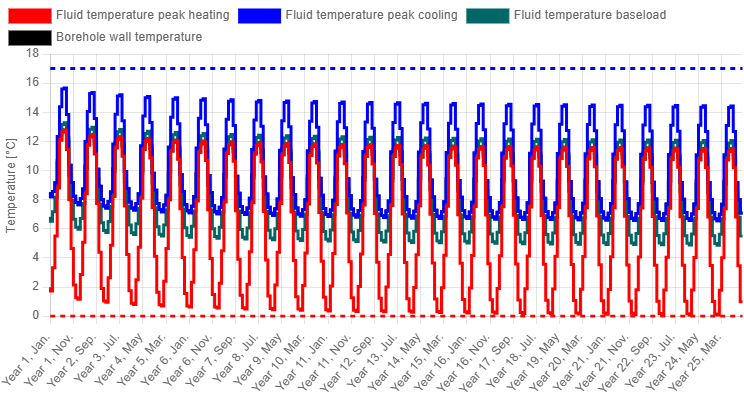
This simulation remains comfortably within the limits, with a minimum average fluid temperature of 0.07°C. The Reynolds number during extraction is 1404, meaning that the flow is laminar, resulting in an effective borehole thermal resistance of 0.1417 mK/W.
When the same simulation is performed for a single U-tube, the minimum average fluid temperature becomes 0.09°C, which is practically identical. This is because the Reynolds number during extraction is now 2812, meaning that the flow is transient and the borehole resistance is therefore 0.1409 mK/W, which is almost identical to the double U-tube case.
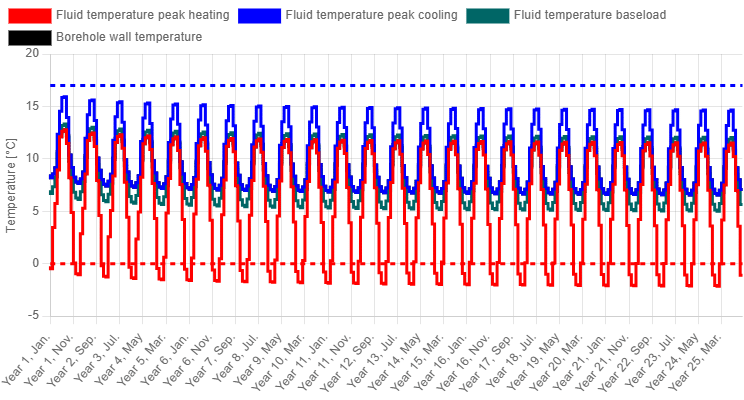
In the graph below, the same exercise was performed for a single DN40 probe, but since the flow is now laminar (Re = 2009), the borehole resistance is significantly higher (0.2111 mK/W), leading to a low minimum average fluid temperature of -2.15°C.
Conclusion
In this chapter, the focus was on the question: “Which is better: the single or the double U-tube?” Looking at it from a thermal perspective, it became clear that there is no definitive answer to this seemingly simple question, since it depends on the fluid temperature, flow rate and even the grout thermal conductivity.
The key takeaway is that every project is unique and, depending on the specific conditions, one solution may sometimes be better than the other. Sticking with a one-size-fits-all approach has been shown to carry an inherent risk since, sooner or later, that solution may actually prove to be insufficient or, on the other hand, excessive.
In the next chapter, the hydraulic aspects related to this question will be discussed.
Questions
Downloads
- Download GHEtool simulation from this chapter here.