
One key concept in the world of borefield design is the effective borehole thermal resistance which is a measure for how good your borehole can exchange heat with the ground. This is the first of two concepts that are important to understand the thermal behaviour of your borefield.
Thermal behaviour of a borefield
Before we introduce the concept of the effective borehole thermal resistance, let us take a look at the temperature profile below. Basically, we can distinguish two different trends:
- A seasonal and yearly variation in the borehole wall temperature, indicated by the black line
- A certain difference between the borehole wall temperature and the fluid temperatures

Since the goal of borefield design is to make sure that the fluid temperatures stay within certain limits, it is important to understand both effects. The first, seasonal and yearly effect, is called the long-term behaviour of the borefield and will be discussed in the next chapter. The difference between the borehole wall temperature and the (three) fluid temperatures is, the short-term effect, and is given by the following relationship:
$$\overline{T}_f(t)=\overline{T}_b+\dot{q}(t)\cdot R^*_b$$where $\overline{T}_f(t)$ is the average fluid temperature (either for extraction, injection or baseload) at time $t$, $\overline{T}_b(t)$ the borehole wall temperature at time $t$, $\dot{q}(t)$ the specific heat extraction/injection at time $t$ and $R^*_b$ the effective borehole thermal resistance. This is also illustrated in the image below.

The formula above makes it clear why we can distinguish between a short-term and long-term borefield behaviour. When we are now, instantaneously, extracting power from the ground, our fluid temperature will be influenced, but our borehole wall temperature will stay more or less constant. However, if we do this days (or years) continuously, then this $\overline{T}_b$ will also start to change.
Therefore, one could say that the short-term effects are power related whereas the long-term effects on the borehole wall temperature are energy related.
This formula makes it clear that the temperature difference $\Delta T$ between our source (the borehole wall temperature) and the fluid is:$$\Delta T = \dot{q}(t)\cdot R^*_b$$
Specific heat extraction
The specific heat extraction $\dot{q}(t)$ is a measurement of the power per unit borehole length that passes through the borehole wall. If you have for example a borehole of 100 m deep and a power of 1 kW extracted from it, the specific heat extraction at that time is 10 W/m. However, if the same power would be drawn from two boreholes of 100 m, the specific heat extraction would only be 5 W/m.
In the second case, the difference between the fluid temperature and the borehole wall temperature would be only half that of the single borehole, bringing the fluid and borehole wall temperature close to each other.
So, for the short-term effect, it is beneficial to have more borehole meters.
This is a rather contradictory conclusion: if we want to make the borefield smaller, we want our fluid temperature to be close to the borehole wall temperature, but therefore, it would be better to have a higher total borehole length!
The solution lies in the other factor in the equation: the effective borehole thermal resistance.
Effective borehole thermal resistance
The effective borehole thermal resistance is a measure of how good the borehole can exchange heat with the ground and we typically want it to be as small as possible (normally it is between 0.05-0.25 mK/W). In the image below, this resistance is shown schematically.
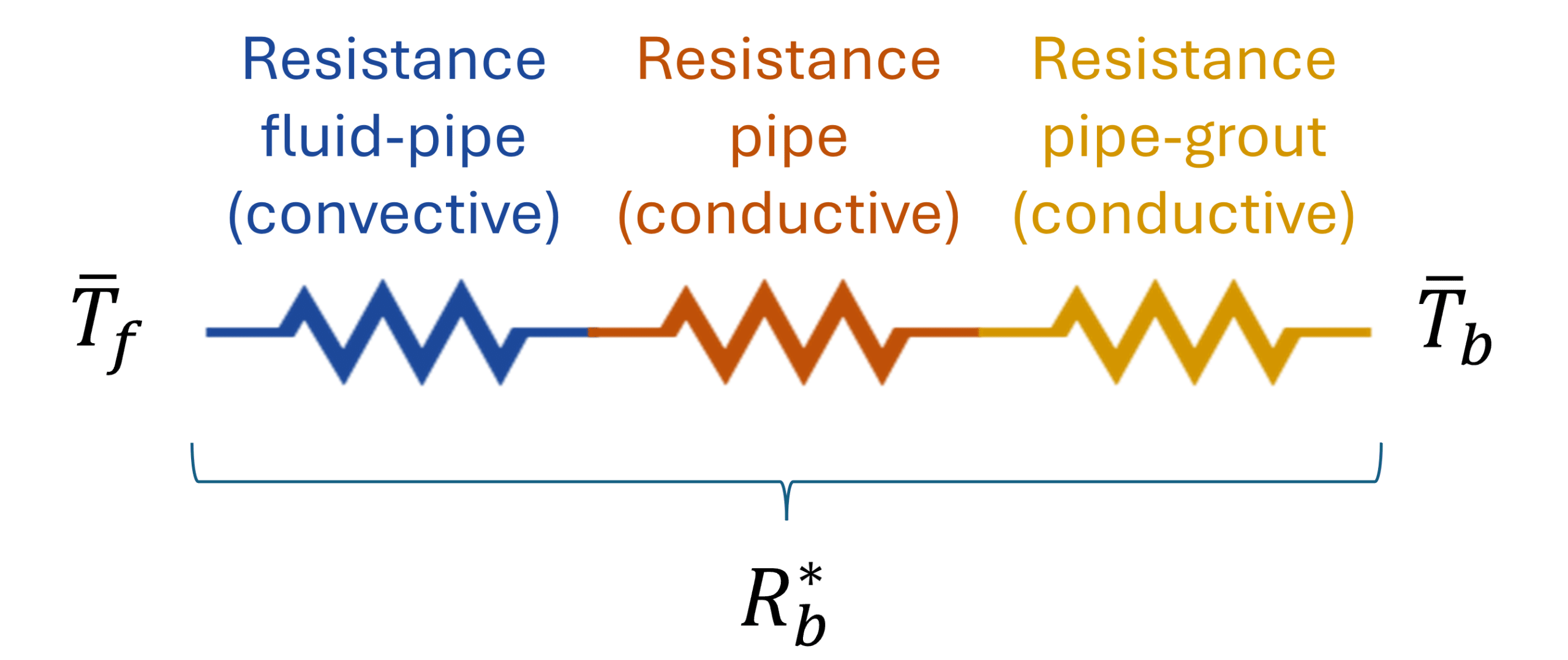
We can clearly identify three different contributions to the overall resistance:
-
From the fluid to the pipe (convective heat transfer)
-
Through the pipe (conductive heat transfer)
-
Through the grout to the borehole wall (conductive heat transfer)
If we want to make the borehole resistance as small as possible, these are the three elements we need to focus on. Let’s discuss them one by one.
The resistances shown above are an oversimplification of reality, since in reality the pipes also interact with each other. A more accurate representation for the resistance of for example a double U probe, is shown below.

Based on the thermal resistances above, two resistances can be calculated: the borehole resistance $R_b$, expressing the resistance between the pipes and the borehole wall, and the internal resistance $R_a$, which encompasses the internal interactions between the different pipes.
With the assumption of a constant borehole wall temperature, the effective borehole thermal resistance can be calculated as: $$R^*_b=R_b\cdot \eta \cdot coth(\eta)$$where$$\eta=\frac{Rv}{\sqrt{2R_bR_a}}$$and$$R_v=\frac{H}{\rho_f c_f V_f}$$with $H$ the borehole length (m), $\rho_f$ the density of the fluid in (kg/m³), $c_f$ the specific heat capacity of the fluid in (J/(kgK)) and $V_f$ the flow rate through one pipe in (m³/s). Some references related to explicit calculation methods and the general multipole method are available at the end of this chapter.
Another important element to keep in mind is that the effective borehole thermal resistance is a steady-state model, which means that the thermal inertia of the fluid and the ground is not taken into account. Therefore, if you have an extraction of 10 kW for just one hour, this would have an immediate effect on the fluid temperature, however in reality, the thermal capacity of the fluid would dampen this peak temperature. This can be seen as an inherent safety when designing borefields with design software.
In a future update of GHEtool, we plan on implementing a more accurate, less conservative model for this.
Fluid resistance
The first important term in the effective borehole thermal resistance relates to the convective heat transfer from the fluid to the pipe. This is highly influenced by the flow regime of the fluid, which can be either laminar or turbulent.
In a laminar flow rate, all the fluid particles move in parallel trajectories and it can be compared to the situation where you open your water tap ever so slightly. In this case, the heat, carried by the fluid droplets in the middle of the pipe, never touch the borehole wall and they need to transfer the heat with conduction through the other fluid layers. This is very inefficient and leads to a higher resistance.
On the other hand, when you open the water tap to the fullest, the fluid becomes turbulent. In this case, the fluid is constantly mixed so all our warm fluid droplets can touch the pipe wall at one moment or another, making it better for the heat transfer. On the other hand, as we will see later in this course, turbulence is not so ideal for the pressure drop and pump energy.
In between those two regions, there is something called the transition zone, where the fluid is not laminar nor turbulent but transitioning from one to the other. There is not much known about this fluid regime from a theoretical point of view, but it can be understood from reasoning that it is unphysical that the laminar flow switched directly from a laminar to a turbulent flow.
In the image below, this is shown graphically.

Since the flow regime will play a central role in many of the chapters to follow, it is important that we learn how we can quantify whether the flow is laminar or turbulent. This can be done with the Reynolds number.
Reynolds number
The Reynolds number is a non-dimensional number, i.e. a number without a unit, which tells you something about the fluid regime inside the borefield and it is defined as follows:$$Re=\frac{\rho D \dot{V}}{\mu}$$where $\rho$ is the fluid density in (kg/m³), $D$ is the pipe diameter in (m), $\dot{V}$ is the flow velocity in the pipe in (m/s) and $\mu$ is the dynamic viscosity of the fluid in (pa.s).
It is assumed that all flows with Re<2300 are laminar and that flows which have Re>4000 are turbulent. All flows in between those numbers are neither laminar nor turbulent. The borehole thermal resistance is hence interpolated for these cases. This approach was described by Gnielinski (2013).
Based on the Reynolds number, we can see that if we were to increase the flow rate (and hence the flow velocity) our Reynolds number would increase and we can end up in a turbulent regime which is good for heat transfer. Similarly, changing the fluid properties (as we will discuss in the next part) can also have a very significant influence on the borehole thermal resistance.
Reynolds number and the convective fluid resistance
To illustrate the importance of the Reynolds on the effective borehole thermal resistance, below, the resistance is shown for a variety of Reynolds numbers for both GHEtool as well as Earth Energy Designer. The threshold of 2300 is clearly visible here as the borehole resistance drops off significantly after that. In EED, the jump is immediate, since it does not account for the transition region of the fluid. When the fluid is fully turbulent (Re>4000), one can see that the resistances align.

Pipe resistance
The pipe resistance is typically not something you have an influence on, since it is determined by the pipe material (which is typically a given). The higher your pressure rating of your pipe, the thicker your wall will be and the higher the contribution to the overall resistance.
However, there are some commercial products that you can opt for to minimise the pipe resistance:
- GEROtherm VARIO and FLUX probes
HakaGerodur has developed conical probes, with the advantage of having a lower pressure drop for the same pressure rating, however, this design has the added benefit that the wall thickness is smaller on average, minimising the pipe resistance. (These products are implemented in GHEtool Cloud. More information on the website of HakaGerodur.) - Hipress
The hipress probe from Jansen has a metal inner layer which has a significantly better thermal conductivity than the traditional plastic (up to 0.5 W/(mK) instead of 0.4 W/(mK)), leading to a lower pipe resistance. (Not yet implemented in GHEtool (Feb 2026), but you can enter it using a ‘custom U-tube’. More information on the website of Jansen.)
Grout resistance
The last resistance the heat must pass through is the resistance from the pipe, through the grout, to the borehole wall. Here, again, there are several parameters we can influence.
Distance between the pipe and the borehole wall.
In the case of U-tubes, one can say that the closer they are to the borehole wall, the lower the grout resistance will be, as the heat has less grout to pass through. However, this is not something that can be easily measured or predicted. In general, it can be said that, if you work with a smaller borehole diameter, this component of the pipe-to-grout resistance will also be lower. That said, borehole diameter is often limited and determined by the geological conditions at your specific location. As a general rule of thumb, we suggest placing the U-tubes in GHEtool halfway between the borehole centre and the borehole wall (see graph below).

Grout thermal conductivity
Another important factor influencing the grout resistance is the grout’s thermal conductivity. The higher this conductivity, the lower the resistance for heat transfer through the borehole. Typically, this value ranges from 0.6 W/(mK) up to 2.5 W/(mK) for thermally enhanced grout, where materials such as graphite are used to improve thermal properties. This can have a significant impact on your geothermal design, but also on your installation costs, as grouts with better thermal conductivity tend to be more expensive.
Not all boreholes are grouted by definition. In the Scandinavian countries for example, where the boreholes are drilled in hard rock, ground-water filled boreholes are rather common.
These systems are not only cheaper, but they also have the benefit that a lower pressure class for the pipe can be used (reducing the pipe resistance). This is because the ground-water creates a hydrostatic pressure more or less equal to the one in the probe, meaning there is a rather small pressure difference. Therefore, in for example Sweden, they can drill a couple of 100 meters with a PN10.
Having ground-water as a filling material, makes it hard to estimate the grout thermal conductivity. The conductivity of water is around 0.6 W/(mK), but the water in the borehole is not standing still. Due to temperature differences between the top and the bottom of the borehole, there are some buoyancy effects causing the fluid to move. This causes a convective heat transfer, outside of the pipes, increasing the effective conductivity significantly with a factor 2 to 3, when compared to static water (Johnsson and Adl-Zarrabi, 2019).
However, the simulation with ground-water filled boreholes is not trivial, since the buoyancy depend on the temperature, which vary over time. We are researching the latest models to see if we could explicitly add a ground-water filled option in GHEtool as well.
Single or double U tube
If you are working with a U-tube, installing a double U-tube can reduce the pipe-to-grout thermal resistance, as the increased surface area allows for more efficient heat transfer.
Conclusion
The thermal behaviour of borefields can be divided into a short-term and a long-term behaviour. The first one is influenced by the effective borehole thermal resistance, a measure of how good the borehole can exchange energy with the ground as well as the total borehole length.
We discussed that the borehole resistance consists of multiple subresistances that each can be optimised to minimise the overall resistance and hence improve the thermal performance (or the size) of the system. One can for example change the flow rate so the fluid becomes turbulent to enhance the heat transfer or work with a different type of grout to minimise the the grout resistance.
All these aspects are important when it comes to borefield design and will be discussed further later this part when we will make our first geothermal simulation in GHEtool. But before we can do that, we need to talk about the long-term effects in the next chapter.
Questions
References
- Gnielinski, V. (2013). On heat transfer in tubes. International Journal of Heat and Mass Transfer, 63, 134–140. https://doi.org/10.1016/j.ijheatmasstransfer.2013.04.015
- Claesson, J., & Javed, S. (2019). Explicit multipole formulas and thermal network models for calculating thermal resistances of double U-pipe borehole heat exchangers. Science and Technology for the Built Environment, 25(8), 980–992. https://doi.org/10.1080/23744731.2019.1620565
- Claesson, J.; Javed, S. (2018). Explicit Multipole Formulas for Calculating Thermal Resistance of Single U-Tube Ground Heat Exchangers. Energies, 11, 214. https://doi.org/10.3390/en11010214
- Prieto, C., & Cimmino, M. (2021). Transient multipole expansion for heat transfer in ground heat exchangers. Science and Technology for the Built Environment, 27(3), 253–270. https://doi.org/10.1080/23744731.2020.1845072
- Johnsson, J., Adl-Zarrabi, B. (2019). Modelling and evaluation of groundwater filled boreholes subjected to natural convection. Applied Energy, 253, 113555, ISSN 0306-2619, https://doi.org/10.1016/j.apenergy.2019.113555
- Todorov, O., Alanne, K., Virtanen, M., & Kosonen, R. (2021). Different Approaches for Evaluation and Modeling of the Effective Thermal Resistance of Groundwater-Filled Boreholes. Energies, 14(21), 6908. https://doi.org/10.3390/en14216908