
In this chapter, the modelling of the MuoviELLIPSE from MuoviTech is explained, together with an introduction to the boundary element method for calculating the effective borehole thermal resistance of irregular probe shapes.
MuoviELLIPSE
The MuoviELLIPSE is, as the name suggests, an elliptical heat exchanger developed by MuoviTech. Like its counterpart, the TurboCollector, which was discussed in the previous chapter, the MuoviELLIPSE features multiple small fins along its inner surface. These fins are oriented alternately in clockwise and counterclockwise directions along the length of the pipe. Acting as passive turbulators, they are designed to induce turbulent flow behaviour at lower flow rates, thereby enhancing heat transfer. For this particular probe design, the transition to turbulence starts at approximately Re = 1850 instead of Re = 2300 for smooth pipes.
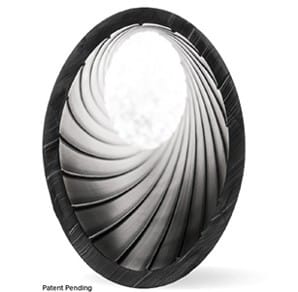
As is clearly visible, the MuoviELLIPSE differs from traditional smooth round pipes in two ways:
- The fluid behaviour inside the probe is affected by the internal fins and the elliptical shape.
- The heat transfer outside the probe, but within the borehole, is influenced by its irregular geometry.
To model the MuoviELLIPSE correctly, both aspects must be considered. The first aspect can again be addressed using direct numerical simulation (DNS), as was also done for the TurboCollector in the previous chapter. Since the methodology is the same, only the results are discussed below.
The other major difference, however, is the probe geometry, which changes the heat transfer within the borehole itself. To account for this, the Boundary Element Method (BEM) is used. Both aspects are discussed below.
Model development
In order to model the MuoviELLIPSE, the correlations for the friction factor and the Nusselt number are first discussed, based on the DNS simulations, after which the concept of the Boundary Element Method (BEM) is introduced to calculate the heat transfer inside the borehole.
Correlation for the friction factor
In the graph below, the friction factor of the MuoviELLIPSE (indicated as ‘Alternating ellipse DNS’) is plotted against the analytical friction factor correlations for both the laminar and turbulent regimes.
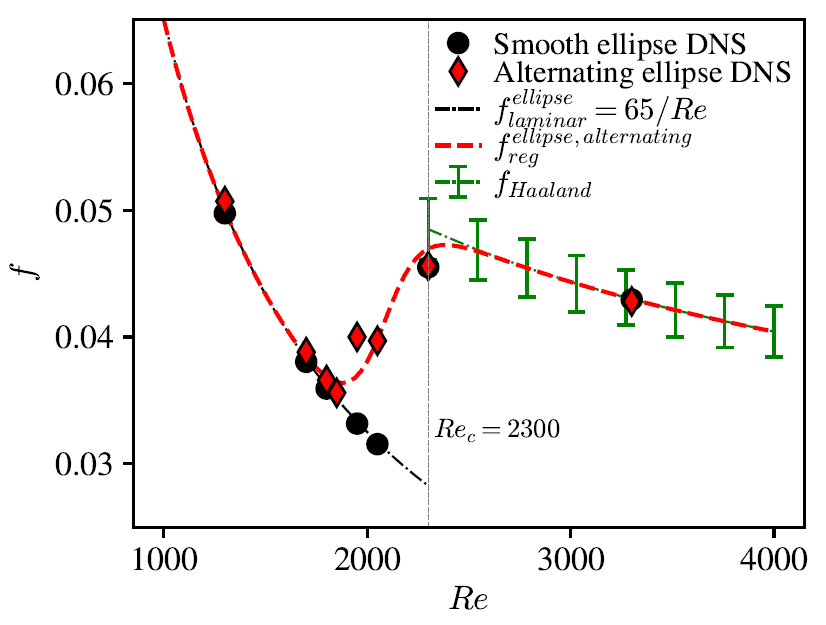
The graph above shows the friction factor for a smooth elliptical probe (reference) as well as the MuoviELLIPSE. Just as with the TurboCollector, it is clear that the transition to turbulence starts earlier in the latter case, at around Re = 1850. In both the fully laminar and fully turbulent regimes, the friction factor of the MuoviELLIPSE is very similar to that of the smooth elliptical probe.
Correlation for the Nusselt number
In the figure below, the Nusselt number is plotted as a function of the Reynolds number for different Prandtl numbers.
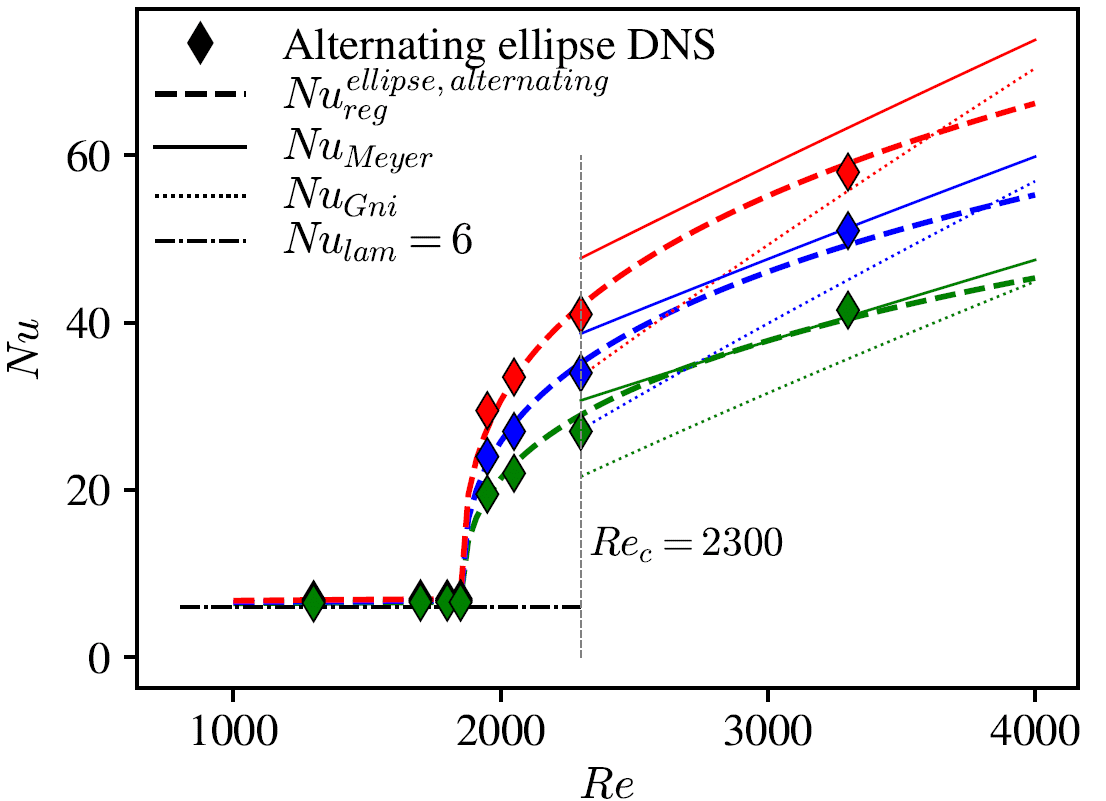
In the graph above, the same transition to the turbulent regime is visible at around Re = 1850. At higher Reynolds numbers, the Nusselt number converges towards the solution for a smooth elliptical probe. The different colours represent different Prandtl numbers, where green represents 20, blue 40, and red 75.
For values Re>4000, the Gnielinksi correlation for the Nusselt number is used, with a constant offset $\delta$ to account for the fins at higher Reynold numbers (just like with the TurboCollector). This offset is defined as:$$\delta = Nu_{Gnielinksi}(4000)-Nu_{MuoviELLIPSE}(4000)$$For the full mathematical details, the user is refered to Niklas et al. (2026).
Boundary Element Method
The previous two correlations describe the thermohydraulic behaviour inside the pipe. However, the second challenge is modelling how the pipe interacts with the borehole and accounting for its elliptical shape. For traditional smooth circular pipes, the internal heat transfer equations can be solved analytically. However, this is no longer possible for non circular geometries.
To overcome this limitation, a numerical approach in the form of the Boundary Element Method (BEM) is employed.
The BEM is a numerical technique used to solve linear partial differential equations (PDEs), such as those governing heat transfer. In the present case, it transforms the original two dimensional problem into an equivalent one dimensional problem defined along the boundaries of the pipes and the borehole wall. Put simply, rather than solving for the entire temperature field within the borehole, it is sufficient to solve an equivalent heat transfer problem only along the pipe surfaces and the borehole wall. This concept is illustrated graphically below.
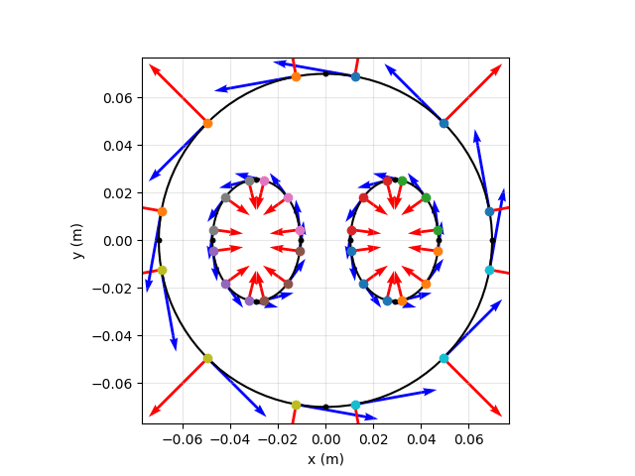
In the figure above, the different points represent the nodes at which the heat transfer equations are solved. The arrows indicate the tangential and normal components of the heat transfer. By discretising the pipe geometry in this way, it becomes possible to accurately account for the true elliptical shape of the probe.
The main drawback of the BEM is that it is computationally intensive and therefore too slow for direct use within GHEtool. To make the model sufficiently fast for practical simulations, an Artificial Neural Network (ANN) is trained using the results of the BEM simulations. This approach combines the best of both worlds: an accurate, geometrically representative model for calculating the heat transfer within the borehole, and an ANN that enables these calculations to be performed efficiently within GHEtool.
An Artificial Neural Network (ANN)is a subclass within the broad field of AI. The concept of an ANN is to mimic the behaviour of the human brain: when we receive sensory input, whether it is smell, touch or sound, it is sent to the neurons in our brain, where the signal moves from neuron to neuron until we arrive at a particular thought, action, sensation and so on. This behaviour, where we start with a set of inputs and move through a series of neurons to reach a particular conclusion, is exactly what we try to model with an ANN. In the figure below, a schematic representation of an ANN is shown.

Depending on the architecture of the ANN, both the number of hidden layers and the number of neurons in each layer can differ. Here, in each node (or neuron), the data are weighted by the value associated with that neuron and passed to the neurons in the next layer. This process is repeated until the output is reached.
Just like a baby entering the world, which still has to learn almost everything, the neural network cannot do anything straight out of the box. That is why such a model must be trained, so that all the weighting factors of the different nodes are calibrated correctly and can convert the inputs into the correct output. In our case, this means predicting the borehole thermal resistance for a given borehole diameter, MuoviELLIPSE size, pipe spacing and grout thermal conductivity.
Based on the models discussed above, the effective borehole thermal resistance and pressure drop of the MuoviELLIPSE are examined below.
Behaviour of the MuoviELLIPSE
Given the two correlations developed above, the effective borehole thermal resistance and the pressure drop of the MuoviELLIPSE are discussed in the next sections.
Effective borehole thermal resistance
The graph below shows the effective borehole thermal resistance for a single and double smooth DN32 U-tube, as well as the MuoviELLIPSE DN32.
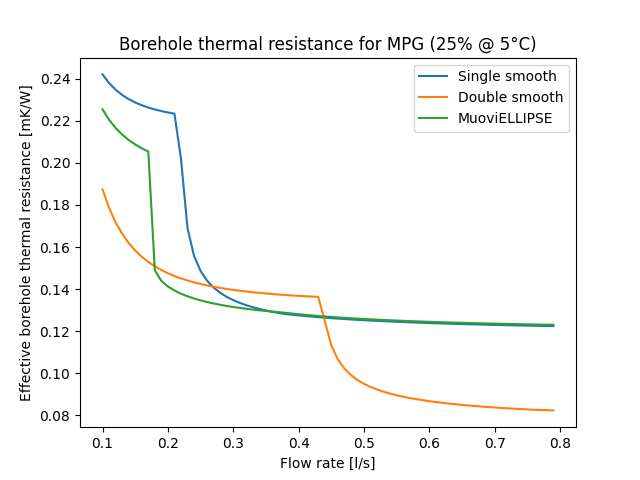
As you can see, the onset of the transition regime occurs earlier for the MuoviELLIPSE than for the equivalent smooth pipes. This means that, when the MuoviELLIPSE DN32 is compared with the smooth double DN32, the range in which the former performs better increases from 0.28 to 0.45 l/s (for the smooth circular probe) to 0.18 to 0.45 l/s. This implies that you can achieve a lower borehole thermal resistance with a single U-tube (MuoviELLIPSE) at a lower flow rate than with a regular smooth DN32.
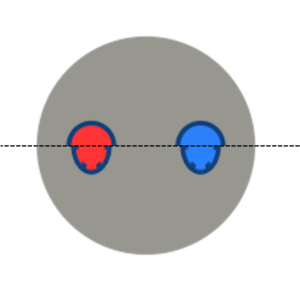
In the turbulent regime, the traditional round pipe has a slightly lower borehole thermal resistance than the MuoviELLIPSE. This is because, due to its shape, the distance between the borehole wall and the pipe is smaller for a circular probe than for an elliptical probe, given the same pipe to borehole centre spacing. When the flow is turbulent, the grout resistance becomes more important, which leads to this effect.
In the image below, this comparison is clearly visible, where the elliptical probe is further from the borehole wall than the circular one.
Another way to take advantage of this earlier transition to turbulence is to use a slightly larger pipe diameter (DN40), as shown in the figure below.
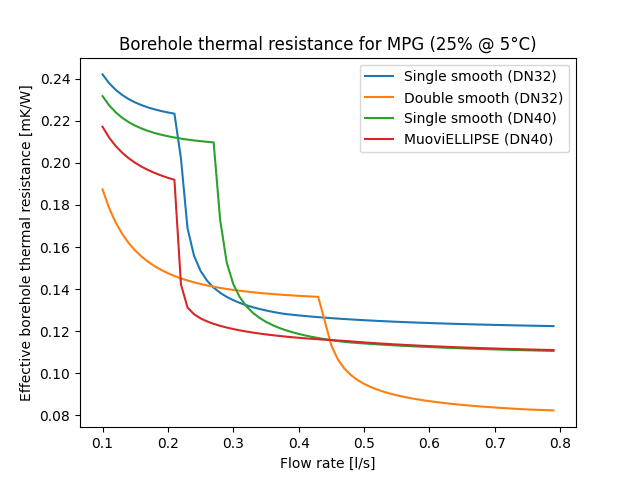
In the figure above, the MuoviELLIPSE also extends the range in which the single U-tube outperforms the equivalent double DN32 U-tube, doubling the range from 0.3 to 0.45 l/s to 0.2 to 0.45 l/s.
Up until now, the performance of the MuoviELLIPSE has been rather similar to that of the TurboCollector, but the main advantage of the elliptical design is that it is possible to use a smaller borehole diameter, thereby reducing the grout resistance. Due to its shape, there is slightly more space available in the borehole when using an elliptical probe, meaning that the borehole diameter can be reduced while still allowing the pipe to be installed. Below, the same graph as above is revisited, but now with the MuoviELLIPSE DN40 in a borehole with a diameter of 100 mm instead of 140 mm.
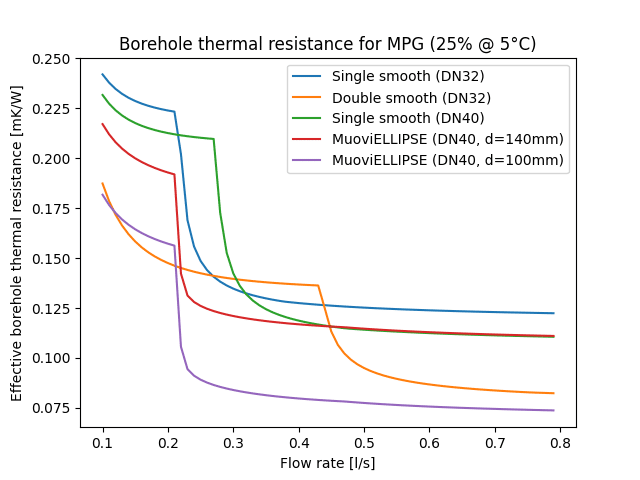
In the graph above, the MuoviELLIPSE DN40 curve is shifted downwards due to the smaller borehole diameter and the corresponding lower borehole thermal resistance. Owing to the smaller borehole diameter of 100 mm compared with 140 mm, it even outperforms the double DN32 case for every flow rate above 0.2 l/s. This highlights the importance of using smaller borehole diameters.
For completeness, the clearance when installing the MuoviELLIPSE DN40 in a borehole with a diameter of 100 mm is shown below.

Pressure drop
In the graph below, the pressure drop is shown for the single and double DN32 U-tube configurations, together with the MuoviELLIPSE DN32.
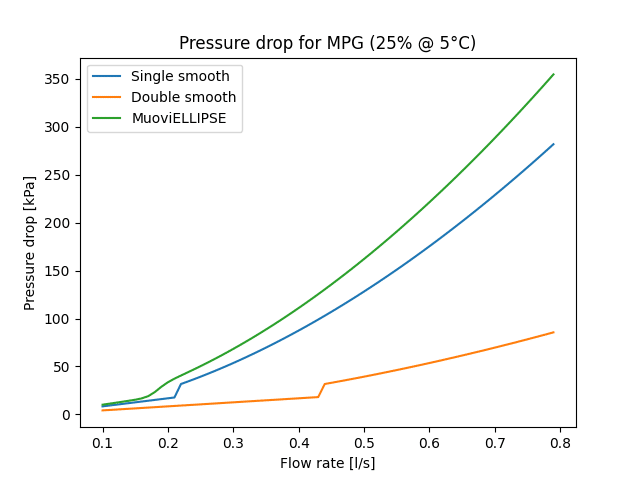
It is clear that the pressure drop starts increasing earlier for the MuoviELLIPSE due to the enhanced turbulence at lower flow rates, which comes at the cost of a higher pressure drop. In addition, the pressure drop of the MuoviELLIPSE is always the highest in this case. This is because, as discussed above, the hydraulic diameter of the MuoviELLIPSE DN32 PN16 is only 24 mm due to its elliptical shape, whereas it is 26 mm for the traditional round probes. This means that, at the same flow rate, the MuoviELLIPSE has a slightly higher flow velocity, resulting in a higher pressure drop.
In the graph below, the comparison with a single DN40 (both smooth circular and MuoviELLIPSE) is shown.
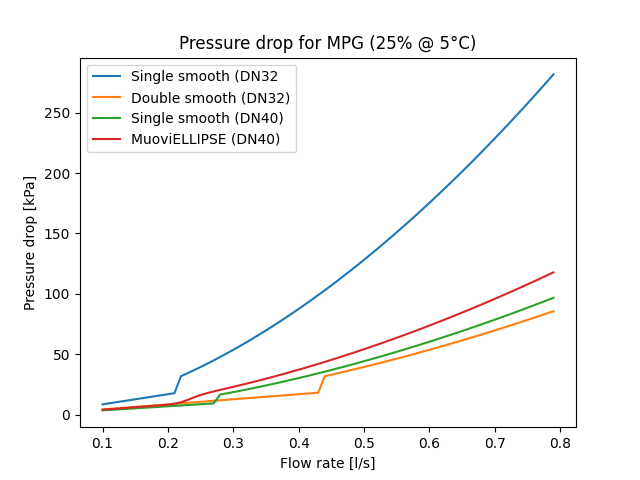
Here, the pressure drop has decreased significantly, but is still, for the reasons discussed above, slightly higher than that of the smooth single DN40 probe. In the laminar regime, however, it performs identically to the double DN32 U-tube.
Conclusion
In this chapter, the MuoviELLIPSE from MuoviTech was introduced. This is an elliptical heat exchanger with the same internal fin structure as the TurboCollector. Therefore, the fluid behaviour is also modelled using direct numerical simulation to derive correlations for the friction factor and the Nusselt number. To account for its irregular shape, the Boundary Element Method was used to numerically solve the heat transfer within the borehole. To speed up these calculations, an Artificial Neural Network was trained using the results of these accurate simulations.
When looking at the effective borehole thermal resistance, the MuoviELLIPSE extends the range in which the flow remains turbulent, or at least transitional, meaning that it extends the range in which a single U-tube outperforms a double U-tube. When a smaller borehole diameter is used, the performance improves even further, outperforming the double U-tube across almost the entire flow rate range. The downside of this enhanced turbulence is an increase in pressure drop, caused by both the internal fins and the smaller hydraulic diameter resulting from its elliptical shape.
References
-
- Katsikadelis, J. T. (2016). The Boundary Element Method for Engineers and Scientists. Academic Press, ISBN: 978-0-12-804493-3
- Hidman, N. (2026). Thermohydraulic performance evaluation of internally finned elliptical geothermal collector pipes. Available online.