You can try GHEtool 14 days for free, no credit card required.
Part 4
Answers
Wouter Peere
Part 4: Answers
In this chapter, we will provide you with the answers to the question at the end of each chapter of the fourth part or the course.
To get as much out of this design course, we highly suggest you try to solve these questions first for yourself before looking at the solution here.
Please note that, since geothermal borefield design is a rather complicated task, there is sometimes no definitive answer. The solutions we propose here are our interpretation of the questions, but this does not necessarily mean that other solutions would not be valid.
Calculate the total local losses, i.e. the sum of all local loss factors, for the hydraulic path indicated in green below. The dotted section can be ignored.
Example of an hydraulic path.
In the hydraulic path above, four 90° bends, one U-bend and two T-junctions (through which the flow of interest passes directly) are shown. According to the table below, the local loss factor is 1.8.
The values for a flanged design are taken from the table below. For more accurate local loss factors, it is recommended to contact the manufacturers of the specific components used. Some 90° bends used in geothermal applications are rounded, whereas others are straight.
Examples of different factors for the local losses. (Source: https://engineerexcel.com/loss-coefficient/)
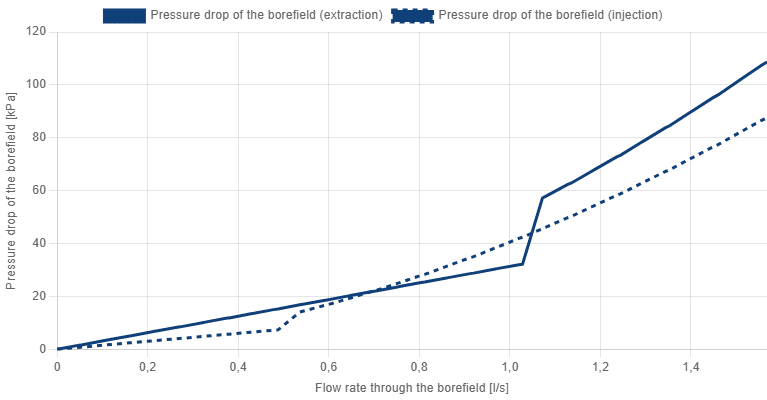
In the graph below, the pressure drops during both heating and cooling are shown, and the transition from laminar to turbulent flow is clearly visible. As expected, the transition from laminar to turbulent flow occurs sooner during cooling, since the Reynolds number is higher. How is it possible that the pressure drop at 0.55 l/s during cooling, which is turbulent, is lower than the pressure drop during heating, which is laminar?
Pressure drop during extraction and injection for different flow rates.
This question illustrates one of the many counter-intuitive results encountered in hydraulic design, since one would normally expect turbulent flow to result in a higher pressure drop than laminar flow. To understand what is happening, let us take a closer look at the friction losses (as the local losses are not relevant to the question at hand):$$\Delta P = f\cdot \frac{L}{D}\cdot \frac{\rho v^2}{2}$$where $\Delta P$ is the pressure drop (Pa), $f$ is the Darcy–Weisbach friction factor, $L$ is the pipe length (m), $D$ is the pipe diameter (m), $\rho$ is the fluid density (kg/m³), and $v$ is the fluid velocity (m/s).
When comparing the pressure drop during extraction and injection at the same flow rate, the fluid velocity in the equation above is identical in both cases. Since the density does not vary significantly with temperature (as discussed here), the $\rho v^2/2$ term remains nearly constant. This means that the only significant difference between the laminar and turbulent cases is caused by the friction factor.
Moody diagram.
In the Moody diagram above, it is clear that the friction factor at approximately Re=1200 (within the laminar regime) is higher than the friction factor in the transitional to turbulent regime. Since switching from extraction mode to injection mode can easily double the Reynolds number, the friction factor in the laminar case can indeed be higher than that in the turbulent case during heat injection. As a result, the pressure drop may be higher in the former situation.
Why is the pressure drop in the graph below, when working with a constant flow rate, higher in winter than in summer?
Example of an hourly pressure drop curve with constant flow rate and only a turbulent flow regime.
The pressure drop in the graph above was obtained when the flow was at least transitional in all seasons, resulting in a continuous line without sudden jumps due to the transition between laminar and turbulent flow. Since the flow rate is again constant, the most important parameter is the friction factor. As the flow is always transitional to turbulent in the case above, only the turbulent part of the Moody diagram is relevant.
In summer, the fluid temperatures are higher, resulting in a higher Reynolds number, a lower friction factor and, therefore, a lower pressure drop. In that sense, the graph above represents exactly the same situation as in the previous question.
In the case of pump energy calculation for a constant flow rate, the fluid temperatures are also taken into account. Why is this necessary, given that the flow rate remains constant?
The pump energy demand $E_e$ in (kWh) is given by: $$E_e=\frac{\sum\limits_{i=0}^{8760 n}{P_e(i)}}{n}$$where $P_e(i)$ is given by:$$P_e=\frac{\dot{Q}\cdot \Delta P}{\eta}$$where$P_e$ is the electrical pump power in (kW), $\dot{Q}$ the flow rate in (m³/s), $\Delta P$ the pressure drop in (kPa) and $\eta$ the electrical pump efficiency.
Although $\dot{Q}$ is independent of the fluid temperature, the pressure drop is not, as discussed previously.
The fluid temperature is important for two reasons:
First, the friction factor depends on the Reynolds number, which is strongly temperature-dependent.
Second, the density is also a function of temperature and affects the pressure drop, although its impact is less significant than that of the friction factor.
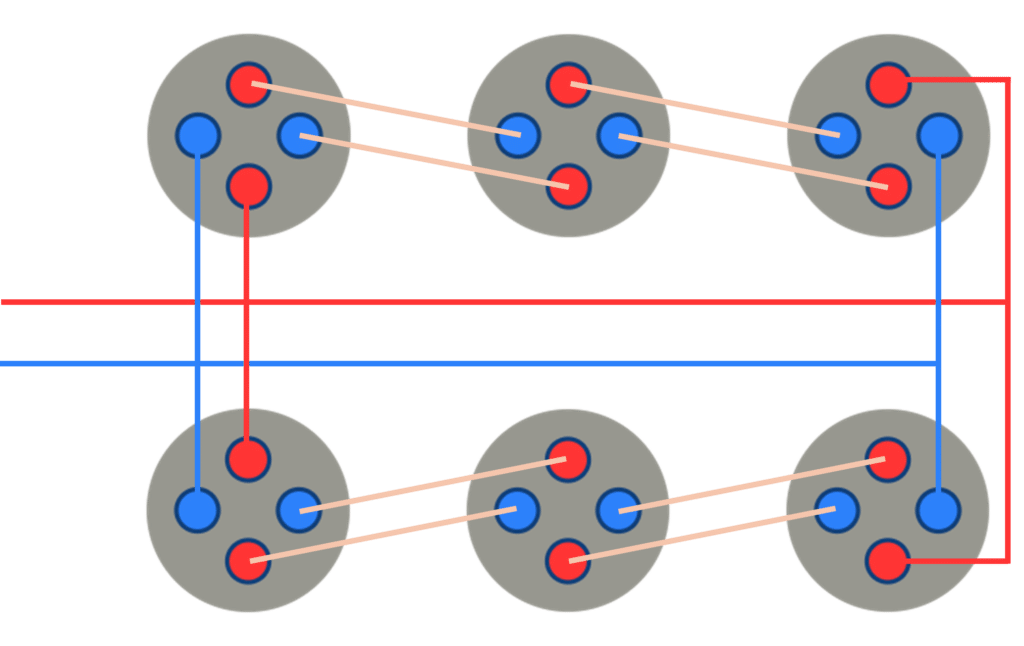
In the hydraulic configuration below, if the inlet flow rate is 1 l/s, what will be the flow rate through each borehole?
Combination of different types of horizontal connections.
The hydraulic configuration above is a combination of series and Tichelmann connections. It can be seen that there are two groups of three boreholes connected in series. A key property of boreholes connected in series is that they all have exactly the same flow rate, meaning they can be considered as one virtual borehole.
This leaves two (virtual) boreholes connected in a Tichelmann configuration, which equally divides the flow between them. As a result, the flow rate is 0.5 l/s per group of boreholes and, consequently, 0.5 l/s per borehole.
Below, an example is given of two boreholes connected in parallel. Can you explain why the two groups above are connected in a Tichelmann configuration instead of a parallel connection?
Example of two boreholes connected in parallel.
The conceptual difference between parallel connections and Tichelmann connections is that, in the latter case, every hydraulic path has the same pressure drop. In practice, this means ensuring that every probe has the same horizontal pipe length, which is not the case for the parallel connection shown above. Here, the last borehole clearly has a longer horizontal pipe length than the first one.
At first sight, the combined situation above may appear to be a simple parallel connection. However, since it consists of groups of boreholes connected in series, the system can be represented as follows, where each group is replaced by an equivalent virtual borehole. This simplification is possible because:
The flow rate through each borehole is identical for all boreholes connected in series.
The pipes in the double U-tube have opposite flow directions: one connection of U-tubes flows from left to right, while the other flows from right to left.
Equivalent situation of the combined hydraulic configuration.
This significantly simplifies the situation, making it clear that the horizontal pipe length in each hydraulic path is, in fact, identical. As a result, this configuration is a Tichelmann connection rather than a parallel one.
Please note that plain parallel connections should generally be avoided in geothermal design because of hydraulic balancing issues. Consequently, it is not possible to model plain parallel connections in GHEtool Cloud.
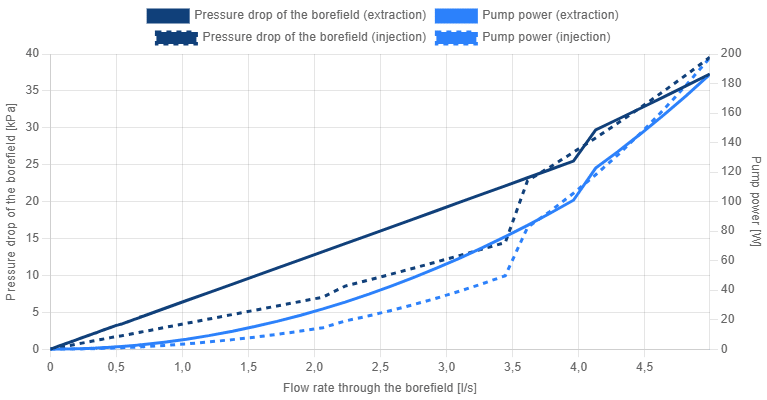
Why are there two jumps in the pressure drop graph during injection, but only one during extraction in the case of a direct connection to the manifold?
Pressure drop graph of the hydraulic simulation using a direct connection.
In injection mode, there is a small jump at around 2 l/s and a larger one at around 3.5 l/s, whereas in extraction mode there is only one jump, at around 4 l/s. When the horizontal connections are considered in the pressure drop calculation, multiple laminar to turbulent transitions can occur, since the vertical probe, the lateral pipes and, optionally, the header pipe can each require a different flow rate to become turbulent.
In the situation above, during extraction, the pipe that becomes turbulent at around 4 l/s is the lateral pipe. However, over the entire flow rate range shown here, the vertical probe remains laminar, meaning that its transition to turbulence lies outside the x-axis range. In injection mode, the horizontal part already becomes turbulent at around 2 l/s, while at around 3.5 l/s the vertical probe transitions to turbulence.
When switching from a direct connection to a series connection of 2 boreholes, what should be changed in the local pressure drop coefficients?
Let us assume that the boreholes are all arranged in one line, so that there are no 90° bends in the horizontal plane. In that situation, the local losses when connecting each borehole directly to the manifold consist of the U-bend at the bottom of the borehole, the 90° bend at the top of the borehole connecting the vertical part to the horizontal connection, and the connection to the manifold itself. If all these local losses are assumed to have a loss factor of 0.5, the total loss factor in this case is 2.5.
If the same boreholes are connected in series, two extra 90° bends, as well as another U-bend, are introduced for each additional borehole in the hydraulic path. Keeping everything else unchanged, the local loss factor then becomes 4. This is also shown in the figure below, excluding the manifold.
Local losses in direct connection versus series connection.
Although the local loss coefficient increases by 50%, the most important contributor to the increase in pressure drop will be the friction losses caused by the higher flow rate in the horizontal piping.
It is possible to convert local losses into equivalent major losses by considering the overall pressure drop equation:$$\Delta P = \left(f\cdot \frac{L}{D}+\sum{K}\right)\cdot \frac{\rho v^2}{2}$$Based on the equation above, it is clear that, for a given friction factor $f$ and pipe diameter $D$, the local losses can be written as friction losses in a pipe with a certain equivalent length $L$: $$L=\frac{K\cdot D}{f}$$For example, when the friction factor is 0.035, a local loss factor of 4 in the case above is equivalent to approximately 3 m of DN32 PN16 pipe, which has an internal diameter of 26 mm.
You can try GHEtool 14 days for free, no credit card required.
Manage Consent
To provide the best experiences, we use technologies like cookies to store and/or access device information. Consenting to these technologies will allow us to process data such as browsing behavior or unique IDs on this site. Not consenting or withdrawing consent, may adversely affect certain features and functions.
Functional
Always active
The technical storage or access is strictly necessary for the legitimate purpose of enabling the use of a specific service explicitly requested by the subscriber or user, or for the sole purpose of carrying out the transmission of a communication over an electronic communications network.
Preferences
The technical storage or access is necessary for the legitimate purpose of storing preferences that are not requested by the subscriber or user.
Statistics
The technical storage or access that is used exclusively for statistical purposes.The technical storage or access that is used exclusively for anonymous statistical purposes. Without a subpoena, voluntary compliance on the part of your Internet Service Provider, or additional records from a third party, information stored or retrieved for this purpose alone cannot usually be used to identify you.
Marketing
The technical storage or access is required to create user profiles to send advertising, or to track the user on a website or across several websites for similar marketing purposes.